
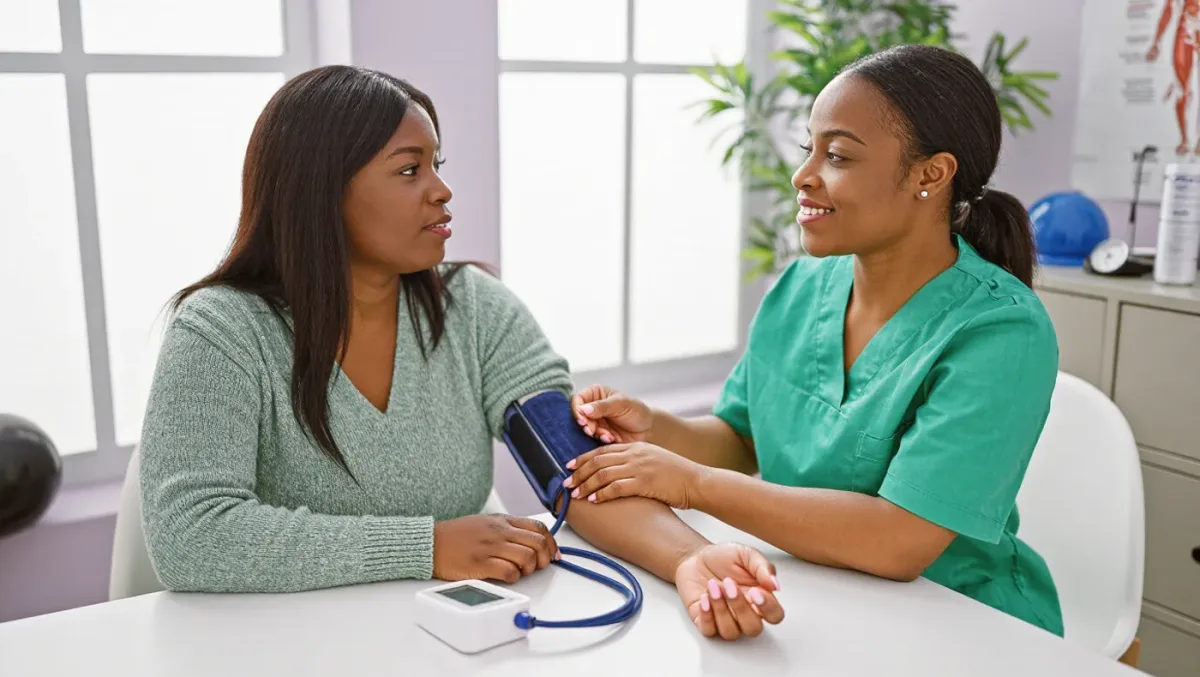
Blood pressure matters for women because it is the single most modifiable risk factor for heart disease — the leading cause of death for US women — and because nearly half of adults have hypertension, about 48 percent in CDC analysis of national survey data (2017–2020). High blood pressure usually causes no symptoms at all, which is exactly why guidelines rest on measurement, and why a woman's blood pressure history deserves attention at each distinct phase of her life: contraception years, pregnancy, and menopause.
Blood pressure is the force of blood pushing against artery walls, recorded as two numbers — systolic (pressure when the heart beats) over diastolic (pressure between beats). This article explains how high blood pressure is defined, why its course differs for women, and what screening guidelines say. It publishes information, not medical advice — diagnosis and treatment decisions belong to you and your clinician.
What counts as high blood pressure?
Per the American College of Cardiology and American Heart Association guideline issued in 2017, blood pressure falls into defined categories: normal is below 120/80 mm Hg; elevated is a systolic of 120–129 with diastolic below 80; stage 1 hypertension is 130–139 or 80–89; stage 2 hypertension is 140/90 or higher. Diagnosis is not made on one reading — guidelines call for multiple measurements on separate occasions, and the USPSTF's 2021 recommendation specifies that confirmation should ideally use measurements taken outside the office, at home or with ambulatory monitoring, because single office readings over- and under-diagnose.
| Category (ACC/AHA 2017) | Systolic (mm Hg) | Diastolic (mm Hg) |
|---|---|---|
| Normal | Less than 120 | and less than 80 |
| Elevated | 120–129 | and less than 80 |
| Stage 1 hypertension | 130–139 | or 80–89 |
| Stage 2 hypertension | 140 or higher | or 90 or higher |
| Hypertensive crisis | Higher than 180 | and/or higher than 120 |
How often should blood pressure be checked?
The USPSTF recommended in 2021 that all adults 18 and older be screened for hypertension with office blood pressure measurement — annually for people 40 and older or with elevated readings, and every 3 to 5 years for younger adults with normal readings. Screening works because hypertension is silent: by the time symptoms appear, damage to blood vessels, the heart, the kidneys, or the eyes may be underway. Home monitoring fills the gaps between visits, and a validated upper-arm cuff device with a proper-sized cuff is the standard — wrist and finger devices are less accurate, per the AHA.
Why do women's risks look different?
For most of adulthood, men and women diverge less than commonly assumed — but three phases are distinctively female. First, contraception: combination hormonal contraception can raise blood pressure modestly in some users, and per the CDC's Medical Eligibility Criteria (2016, current through this period), hypertension generally moves combination pills, patches, and rings into a caution or avoid category, while progestin-only and non-hormonal methods are not similarly restricted. Second, pregnancy: hypertension complicates about 1 in 7 US pregnancies, per CDC estimates, and preeclampsia — new-onset high blood pressure with organ involvement after 20 weeks of pregnancy — affects roughly 1 in 25. Third, menopause: blood pressure rises steeply in women after midlife, and by older age more women than men have hypertension.
Does preeclampsia history change the decades after?
It does, and this is among the most useful facts in prevention. A 2020 American Heart Association scientific statement on pregnancy and cardiovascular health summarized the evidence: women with a history of preeclampsia face roughly double the lifetime risk of cardiovascular disease compared with women who had normotensive pregnancies, with risk appearing about 10 years earlier. The statement's framing is the important part — a preeclampsia history is now treated as a risk-enhancing factor that belongs in every later cardiovascular conversation, and it is worth telling any new clinician about it even decades after the pregnancy.
Related stories: Prediabetes and Diabetes Screening: What the Guidelines Say, and What the Numbers Mean · HPV Vaccine Catch-Up in Adults: Who Still Qualifies, and Through What Age.
Why does menopause move the numbers?
Estrogen decline, arterial stiffening, weight redistribution, and sleep disruption after menopause all push systolic pressure upward, per the AHA's 2020 statement and observational data. The result is a crossover: before midlife, women's average blood pressure runs lower than men's; after roughly the mid-50s, it runs higher, and women account for a growing share of uncontrolled hypertension. Menopausal symptom treatment does not substitute for blood pressure management — they are separate conversations, though they can happen in the same visit.
What does treatment actually involve?
Per the ACC/AHA 2017 guideline, adults with stage 1 hypertension and no cardiovascular disease start with lifestyle change and repeat measurement within months: the documented measures include weight management, the DASH eating pattern, reduced sodium intake, regular aerobic activity, and moderating alcohol. Medication enters for stage 2 hypertension, for anyone with existing cardiovascular disease, or for stage 1 with elevated overall risk — a calculation that includes age, diabetes, and other factors. Specific drug choices, including which classes are preferred in pregnancy or possible pregnancy, are individual clinical decisions; ACE inhibitors and ARBs, common blood pressure drugs, are avoided in pregnancy per the guideline. This article does not recommend doses or protocols — the numbers above are attributed facts, not the site's advice.
When to talk to a clinician
Seek urgent care for a reading above 180/120 with symptoms such as chest pain, shortness of breath, severe headache, vision changes, or weakness — that combination is a hypertensive crisis. Schedule a visit if home readings repeatedly sit at 130/80 or above; if you are planning pregnancy and have any history of elevated blood pressure or preeclampsia; if you take combined hormonal contraception and your readings have crept up; or if you have readings of 140/90 or higher at any age. One elevated reading at a pharmacy kiosk is a prompt to measure again properly, not a diagnosis.
Frequently asked questions
My pressure is fine at the doctor's but high at home. Which counts?
Both patterns exist — masked hypertension is real high pressure hidden by normal office readings, and white-coat hypertension is the reverse. Per the USPSTF's 2021 recommendation, confirmation with out-of-office measurements is the standard precisely because office readings alone misclassify people. Bring your home log to your clinician; a validated arm cuff and correct technique make those numbers usable.
Do birth control pills cause high blood pressure?
They can raise blood pressure modestly in some users, particularly those who already have elevated readings or are older. Per the CDC's Medical Eligibility Criteria (2016), established hypertension is a reason to avoid combination estrogen-containing methods and choose alternatives. This is a reason for routine blood pressure checks when starting or renewing contraception, not a reason to avoid contraception — many options are suitable with hypertension.
Is low blood pressure a problem too?
Usually not. Many healthy women run systolic pressures in the 90s without symptoms, and low readings alone are not treated. What matters is symptoms — persistent dizziness, fainting, or lightheadedness on standing — which deserve evaluation, especially if a new medication could be contributing. Per AHA guidance, it is the symptomatic pattern, not the number alone, that prompts action.
Can menopause hormone therapy raise blood pressure?
Most evidence is reassuring at the population level, but context matters. Per the AHA's 2020 scientific statement, starting menopausal hormone therapy in women with untreated or uncontrolled hypertension requires caution and blood pressure control first, while therapy initiated near menopause in otherwise healthy women has not shown the same concerns. This is a case where your full history — pressure readings, method, dose, and timing — genuinely changes the answer a clinician gives.