
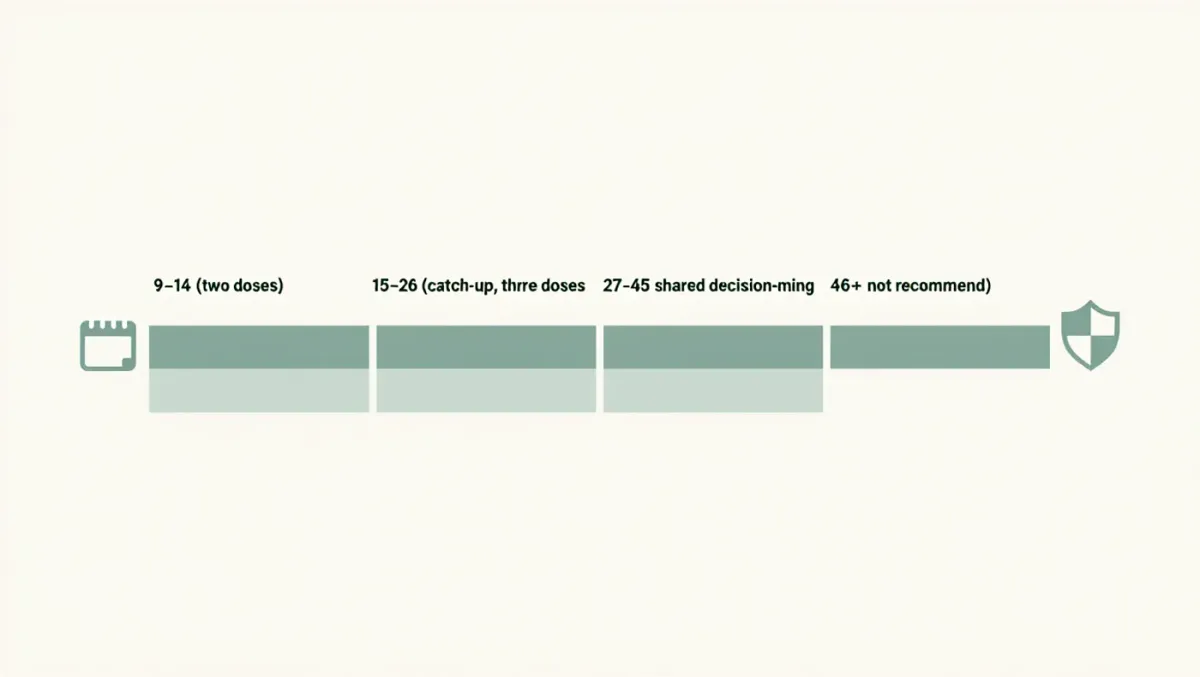
If you are 26 or younger, the answer is straightforward: catch-up HPV vaccination is recommended through age 26, ideally well before then. Per the Advisory Committee on Immunization Practices (ACIP) guidance published by the CDC in 2019, routine vaccination is recommended at ages 11 to 12 and catch-up vaccination continues through 26; between 27 and 45, vaccination is available through shared clinical decision-making — meaning you and your clinician weigh whether it makes sense for you. After 45, HPV vaccination is not recommended by ACIP.
Human papillomavirus, or HPV, is a group of more than 200 related viruses, some of which are spread by skin-to-skin sexual contact and can cause cancer years later. This article walks through who qualifies for catch-up vaccination at each age, how many doses are involved, and what the vaccine can and cannot do. It publishes information, not medical advice — eligibility in your case is a conversation with your own clinician.
Why does the vaccine matter so much for cervical health?
HPV is the cause of nearly all cervical cancers. Per CDC data published in 2024, HPV is linked to more than 36,000 cancer diagnoses in the United States each year, including cancers of the cervix, vagina, vulva, anus, and the back of the throat, with cervical cancer the most common HPV-attributable cancer in women. The vaccines used in the US cover the highest-risk HPV types — the 9-valent vaccine (Gardasil 9) protects against HPV types 6, 11, 16, 18, 31, 33, 45, 52, and 58 — and clinical trials found it close to 100 percent effective at preventing persistent infection and precancerous lesions caused by those types, per a 2007 phase 3 trial in the New England Journal of Medicine (the FUTURE II and PATRICIA-era trials established the principle; the 9-valent formulation showed similar protection against its additional types in a 2015 NEJM study).
What is 'catch-up' vaccination, exactly?
Catch-up means vaccination after the routine target age has passed, to close the gap. ACIP recommends routine HPV vaccination at ages 11 to 12 — doses can be started as early as age 9 — because the immune response is strongest before any HPV exposure, and catch-up vaccination extends eligibility for anyone who missed it. For adults, this has two tiers: through age 26, vaccination is recommended for everyone not already vaccinated; from 27 through 45, the CDC's 2019 guidance supports vaccination based on shared clinical decision-making between patient and clinician.
| Age group | What ACIP recommends (2019 guidance) | Doses |
|---|---|---|
| 9–14 | Routine vaccination (can start at 9) | 2 doses, 6–12 months apart |
| 15–26 | Catch-up vaccination for anyone not vaccinated | 3 doses (0, 1–2, 6 months) |
| 27–45 | Shared clinical decision-making | 3 doses if chosen |
| 46+ | Not recommended | — |
Note the dose difference: starting before the 15th birthday requires two doses; starting at 15 or later requires three. If you began the series as a teen and never finished, you do not restart — you complete the remaining doses, and the schedule does not expire because of the gap between them.
If I'm over 26, is it still worth it?
This is the honest middle ground. By the late 20s and beyond, most sexually active adults have already encountered at least one HPV type — a large US prevalence study published in JAMA in 2007 (Dunne et al.) found that nearly 45 percent of women ages 20 to 24 carried HPV at the time of testing — so the vaccine, which prevents infection rather than treating it, has less to add. But it can still protect against types you have not caught: ACIP's 2019 reasoning for supporting shared decision-making through 45 was precisely that some adults in that window remain unexposed to vaccine-covered types. Your clinician may consider factors such as new partners, a monogamous long-term relationship, or prior abnormal Pap results. If you are 40, newly dating, and unvaccinated, many clinicians will consider the series reasonable; if you are 30, vaccinated-partnered, and have had consistent normal screening, the benefit may be small.
Why is there a hard stop at 45?
The 9-valent vaccine was studied in adults through age 45 — the FDA extended its approval to that age in October 2018 — but ACIP has found the population benefit above 45 too small and too uncertain to recommend vaccination, because prior exposure to relevant HPV types becomes nearly universal. This is a population-level judgment, not a claim that the vaccine stops working biologically. It simply means the panel judged that, on average, adults past 45 gain too little for a blanket recommendation.
Related stories: Why Blood Pressure Matters for Women at Every Phase of Life · Colorectal Cancer Screening Now Starts at 45: Your Options, Compared.
Does vaccination replace Pap tests or HPV screening?
No, and this is worth stating plainly: the vaccine does not cover every cancer-causing HPV type, and cervical screening continues per guideline even for fully vaccinated people. Current US screening guidance, per the American Cancer Society's 2020 guideline, recommends primary HPV testing or co-testing on an interval basis beginning around age 25 for people with a cervix — vaccination changes your risk somewhat, not your eligibility for screening.
What about safety and side effects?
The HPV vaccine has an established safety record. Per CDC safety monitoring, the most common side effects are soreness, redness, or swelling at the injection site, sometimes with dizziness or nausea shortly after the shot; fainting in adolescents after any vaccination led to the standard practice of sitting or lying down for 15 minutes afterward. The vaccine contains no live virus, so it cannot cause HPV infection. It is not recommended during pregnancy, though accidental vaccination during pregnancy has not been associated with harm in monitoring data — the standard practice is simply to finish the series after delivery.
Where does the US stand on coverage?
Progress is real but uneven. Per CDC national immunization survey data published in 2024, roughly three in four US adolescents had received at least one HPV vaccine dose, with completion of the series lower — and uptake has historically lagged in some states and among boys, even though boys are vaccinated on the same schedule and HPV vaccination is recommended for both sexes. Every dose reduces future cancer risk at the population level, which is why catch-up vaccination of the current adult cohort still matters even as teen coverage improves.
When to talk to a clinician
Ask about HPV vaccination at your next visit if you are 26 or younger and have not started or finished the series; if you are 27 to 45 and want to discuss whether shared decision-making vaccination makes sense for your circumstances; if you are unsure how many doses you received as a teen; or if you are immunocompromised, since three doses are recommended for people with immunocompromising conditions even when the series starts at 9 to 14, per ACIP guidance. If you have an abnormal cervical screening result, that is a separate matter to address — but it does not disqualify you from vaccination against types you have not acquired.
Frequently asked questions
I already had an abnormal Pap or was treated for HPV. Can the vaccine still help?
Possibly. Prior infection or treatment for one HPV type does not protect you against the others, and the 9-valent vaccine covers nine types. Per CDC guidance, vaccination after an abnormal result is still offered and may prevent infection with types you have not yet acquired. It will not treat the infection or lesion you already have — that is what treatment does.
How much does the HPV vaccine cost as an adult?
It varies. Private insurance usually covers ACIP-recommended vaccination through 26 without cost-sharing under the Affordable Care Act; coverage for the 27-to-45 shared-decision range varies by plan. The federal Vaccines for Children program covers vaccination through age 18 for eligible uninsured or underinsured patients, and some health departments offer adult doses at reduced cost.
If my partner and I are both unvaccinated adults in our 30s, is it pointless?
Not necessarily pointless, but the benefit depends on your history of exposure. The vaccine protects against types you have not encountered yet. Per ACIP's 2019 guidance, adults 27 to 45 may choose vaccination after discussing their specific circumstances with a clinician — including future partner plans, which matter more than past ones for remaining unexposed types.
Do men benefit too, and why does that matter to women?
Yes — HPV vaccination is recommended for boys and men on the same age schedule, protecting them against oropharyngeal, anal, and penile cancers. Broad male vaccination also reduces transmission in the population, which per CDC data has already contributed to falling HPV infection rates in women. Catch-up rules for adults are identical: through 26, shared decision-making 27 to 45.