
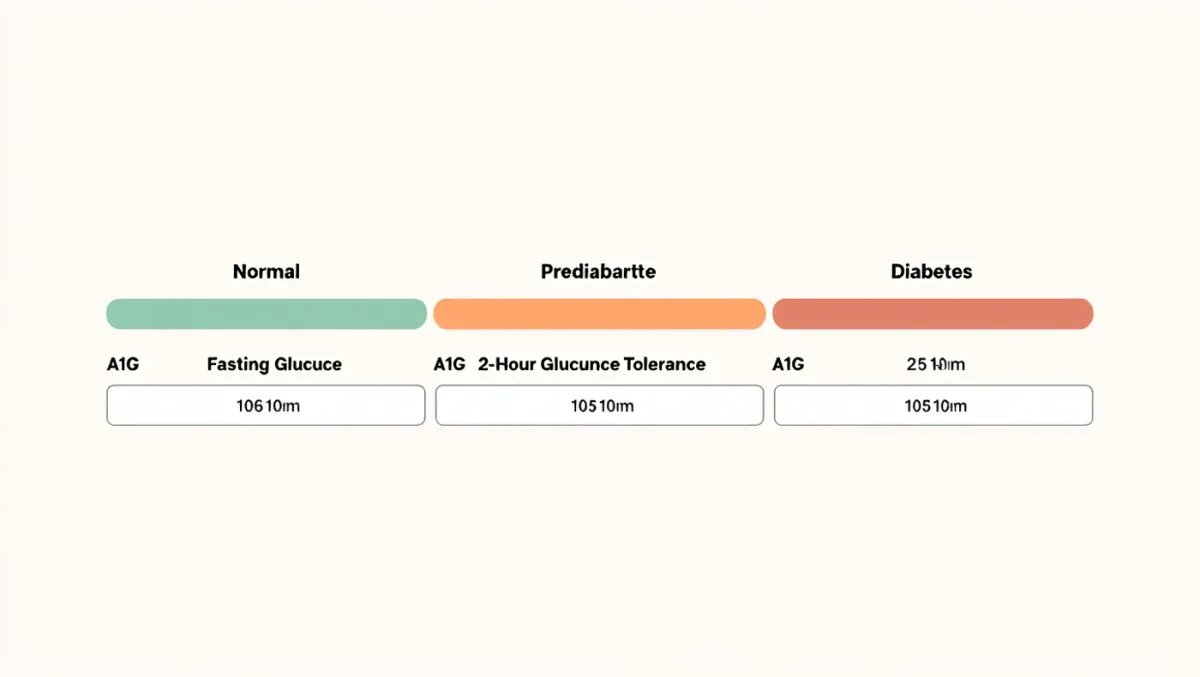
Screening for type 2 diabetes and prediabetes is recommended for all adults starting at age 35, per the American Diabetes Association's Standards of Care (2025 edition), and for younger adults who carry excess weight plus at least one additional risk factor; the US Preventive Services Task Force, in its 2021 recommendation, covers adults 35 to 70 with overweight or obesity. The screening itself is a simple blood test — A1C, fasting glucose, or an oral glucose tolerance test — and the results place you in one of three bands: normal, prediabetes, or diabetes.
The reason screening exists is scale and silence. Per the CDC's National Diabetes Statistics Report (2024), about 98 million US adults — more than 1 in 3 — have prediabetes, a condition in which blood glucose is elevated above normal but below the diabetes threshold, and more than 80 percent of them do not know it. This article explains the tests, the cutoffs, and what a prediabetes result actually means. It publishes information, not medical advice — interpreting your own results is a conversation with your clinician.
What tests are used, and where are the lines?
Three tests can be used, each with defined thresholds per the ADA's diagnostic criteria. Hemoglobin A1C reflects average blood glucose over roughly the past three months; fasting plasma glucose is measured after no food for at least 8 hours; the oral glucose tolerance test (OGTT) measures glucose two hours after a standard glucose drink.
| Test | Normal | Prediabetes | Diabetes |
|---|---|---|---|
| A1C | Below 5.7% | 5.7%–6.4% | 6.5% or higher |
| Fasting plasma glucose | Below 100 mg/dL | 100–125 mg/dL | 126 mg/dL or higher |
| 2-hour OGTT | Below 140 mg/dL | 140–199 mg/dL | 200 mg/dL or higher |
Diagnosis of diabetes is confirmed by a repeat abnormal test on a different day, unless symptoms of marked high glucose are present. A random glucose of 200 mg/dL or higher with classic symptoms also diagnoses diabetes, per ADA criteria.
Why start screening at 35?
The ADA lowered its screening age from 45 to 35 in its 2022 Standards of Care, responding to data that type 2 diabetes was being diagnosed at younger ages and that prediabetes was common decades before diagnosis. The USPSTF arrived at a compatible place in 2021: screen adults 35 to 70 who have overweight or obesity, because for that population screening and early intervention reduced progression and delayed the onset of type 2 diabetes in controlled trials. If your weight is in a healthy range with no risk factors, the 35-start does not necessarily apply — but risk factors deserve an honest look before dismissing them.
Which risk factors move the age down?
Per the ADA's 2025 Standards, adults of any age with overweight or obesity plus one or more of these should be screened earlier: a parent or sibling with diabetes; membership in a higher-risk racial or ethnic group (Black, Hispanic, Native American, Asian, Pacific Islander); a history of gestational diabetes — diabetes diagnosed during pregnancy; polycystic ovary syndrome, or PCOS, a hormonal condition involving irregular ovulation and insulin resistance; hypertension or abnormal cholesterol; physical inactivity; or heart disease, HIV, or certain medications such as long-term steroids. For women specifically, two of these are pregnancy-linked: gestational diabetes, which raises lifetime type 2 diabetes risk dramatically — about half of women with a history of gestational diabetes develop type 2 diabetes within 10 to 20 years, per the CDC — and PCOS, which carries elevated insulin resistance at any weight.
How often is it repeated?
If screening is normal, the ADA recommends repeating at least every three years, sooner if risk factors or weight change. For prediabetes, retesting is typically annual, because prediabetes is not static: per the ADA, progression to diabetes occurs at roughly 5 to 10 percent per year in people with prediabetes, while others drift back to normal. An A1C drifting upward across tests — 5.5 percent, then 5.8 percent — carries more information than any single result, which is one reason the trend line in your chart matters.
Related stories: Colorectal Cancer Screening Now Starts at 45: Your Options, Compared · Why Blood Pressure Matters for Women at Every Phase of Life.
What does a prediabetes result actually mean?
It means the window for prevention is open, and it is well documented. The landmark Diabetes Prevention Program, a randomized trial in the New England Journal of Medicine (2002), found that a structured lifestyle program — diet, activity, weight loss — reduced progression to type 2 diabetes by 58 percent over nearly three years, outperforming metformin, which reduced it by 31 percent; long-term follow-up published in the Lancet (Diabetes & Endocrinology, 2015) found the lifestyle arm delayed diabetes onset by about 4 years on average and metformin by 2 years. The CDC's National Diabetes Prevention Program is the translated, community version of that trial protocol. None of this guarantees an individual outcome — but few preventive interventions in medicine have randomized evidence this strong.
What are the symptoms that should not wait for screening?
Type 2 diabetes often has none, which is why screening rather than symptom-spotting is the strategy. When symptoms of high glucose do appear, they include excessive thirst, frequent urination, blurred vision, unexplained weight loss, and slow-healing cuts or frequent infections. Type 1 diabetes — an autoimmune condition, unrelated to weight or lifestyle — presents more abruptly and can become an emergency with vomiting, rapid breathing, or confusion; those symptoms call for urgent care the same day, not a scheduled screening.
When to talk to a clinician
Ask about screening if you are 35 or older and have never had an A1C; if you are younger with risk factors such as PCOS, a gestational diabetes history, or a first-degree relative with diabetes; if your last test was more than three years ago; or if you are pregnant — gestational diabetes screening is standard between 24 and 28 weeks of pregnancy, per the ADA, and earlier with risk factors. And if you have a prediabetes result, that is precisely the visit to discuss the Diabetes Prevention Program and a retesting plan rather than a reason to put the next appointment off.
Frequently asked questions
Which test is better — A1C or fasting glucose?
Neither is uniformly better; they capture different things. A1C needs no fasting and averages three months, but can read falsely low or high with anemia, hemoglobin variants, pregnancy, or recent blood loss, per ADA criteria notes. Fasting glucose is cheaper and precise but bounces with short-term changes. When results and the clinical picture disagree, clinicians confirm with a second test type — that is standard practice, not indecision.
Can prediabetes go back to normal?
Yes — and demonstrably so. In the Diabetes Prevention Program, intensive lifestyle change cut progression by more than half, and some participants' glucose returned to the normal range, with benefits persisting at long-term follow-up per the 2015 Lancet analysis. Weight loss of around 5 to 7 percent of body weight plus 150 minutes of weekly activity was the trial's formula — attributed facts from the study, not the site's prescription.
Does PCOS mean I will get diabetes?
Not inevitably, but PCOS raises the baseline risk. Insulin resistance is a core feature of PCOS for many women, and per the ADA's Standards of Care, screening for diabetes and prediabetes is recommended at PCOS diagnosis and periodically after, independent of age or weight. The same prevention evidence — activity, weight management, and metformin where indicated — applies to this population, and PCOS management is a good standing context for those conversations.
I had gestational diabetes. What follow-up do I need?
Per the ADA's 2025 Standards, women with gestational diabetes should be tested for diabetes 4 to 12 weeks after delivery using the OGTT or A1C, then screened at least every three years for life. Given that roughly half develop type 2 diabetes within 10 to 20 years, many clinicians test more often — making the post-delivery test and an annual or biennial rhythm a reasonable standing plan to discuss with your clinician.