
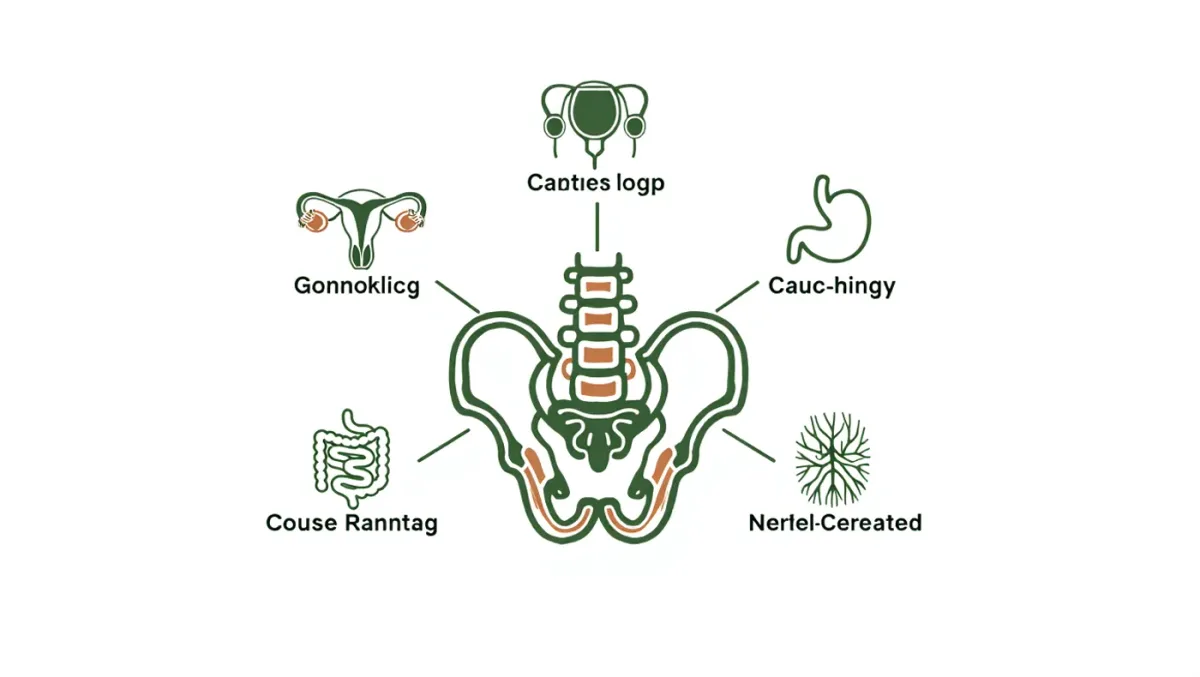
Chronic pelvic pain is pain below the belly button that has lasted six months or longer, and it is common: a 1996 survey by Mathias and colleagues in JAMA estimated that about 15 percent of US women ages 18 to 50 live with it, and ACOG's 2014 committee opinion treats it as a condition with several contributing causes in most women rather than one single culprit. Gynecologic, urinary, gastrointestinal, muscular, and nerve-related sources can each add a share, which is why evaluation looks at the whole pelvis rather than one organ.
This site publishes information, not medical advice. Here we walk through the documented causes, how clinicians sort among them, and what the diagnostic steps involve — as background for a conversation with your own clinician, who can examine you and interpret what your particular pattern means.
Which gynecologic conditions cause it?
Endometriosis — a condition in which tissue similar to the uterine lining grows outside the uterus — is one of the most frequent findings, affecting an estimated 10 percent of reproductive-age women per the World Health Organization's 2023 fact sheet, and it can cause pain both during periods and outside them. Adenomyosis, in which similar tissue grows inside the muscular wall of the uterus, tends to produce heavy, painful periods and a tender, enlarged uterus. Uterine fibroids — benign muscle tumors — can ache or press on nearby structures when they grow large, though per ACOG many fibroids cause no symptoms at all. Pelvic adhesions, bands of scar tissue that form after surgery or infection, can also tether organs and produce pain. None of these diagnoses can be confirmed from symptoms alone; that is what examination and imaging are for.
| Cause category | Examples | Clues clinicians look for |
|---|---|---|
| Gynecologic | Endometriosis, adenomyosis, fibroids, adhesions | Pain with periods, heavy bleeding, pain during sex, tender enlarged uterus |
| Urinary | Interstitial cystitis/bladder pain syndrome, recurrent UTIs | Urgency, frequency, pain that fills the bladder, relief after urination |
| Gastrointestinal | Irritable bowel syndrome, constipation, inflammatory bowel disease | Pain linked to bowel movements, bloating, stool pattern changes |
| Musculoskeletal | Pelvic floor dysfunction, myofascial pain, abdominal wall pain | Pain with sitting, positioning, or pressing on trigger points |
| Nerve-related and other | Pudendal neuralgia, post-infection neuralgia | Burning, shooting or electric-quality pain in specific nerve territories |
What about causes outside the reproductive organs?
A substantial share of chronic pelvic pain has nothing to do with the uterus or ovaries. Irritable bowel syndrome — a disorder of gut-brain interaction causing abdominal pain with changed bowel habits — overlaps heavily with pelvic pain, per ACOG's guidance, and bladder pain syndrome produces pressure and pain that worsens as the bladder fills. The musculoskeletal system contributes more than most people expect: the pelvic floor muscles can become chronically tight and painful, a condition called pelvic floor dysfunction, and per ACOG many women with chronic pelvic pain have at least one tender trigger point in the abdominal wall or pelvic floor that reproduces their pain on examination. This overlap is exactly why a single-organ explanation often falls short.
How is chronic pelvic pain evaluated?
Evaluation starts with a detailed history — timing, cycles, bowel and bladder patterns, sexual activity, prior infections and surgeries — followed by a pelvic examination, during which a clinician can identify cervical motion tenderness, an enlarged uterus, or trigger points. Per ACOG's 2014 committee opinion, transvaginal ultrasound is the usual first imaging step; it detects fibroids, adenomyosis features, and large endometriotic masses, though it cannot rule out peritoneal endometriosis. When imaging is inconclusive and pain persists, laparoscopy — camera-based surgery through small incisions — remains the definitive way to confirm or exclude endometriosis and adhesions, and ACOG notes it is most useful when a specific finding would change management. Keeping a pain diary across a couple of cycles before the appointment gives the history real precision.
Related stories: Why heart attack symptoms differ in women · Why autoimmune conditions disproportionately affect women.
Why do experts talk about a pain cycle?
Chronic pain that persists for months can take on a life of its own. Per ACOG's guidance, long-lasting pain sensitizes the nervous system, so nerves fire more readily and the muscles of the pelvic floor guard against the pain by tensing — which itself becomes a pain source. Sleep disruption, low mood, and stress lower the pain threshold further. This does not mean the pain is imagined; it means the original cause may now be joined by secondary drivers, and effective treatment addresses both. Multidisciplinary care — combining gynecology, physical therapy, pain medicine, and psychological support where relevant — is what ACOG's committee opinion describes as the model with the strongest results.
What treatments does the evidence support?
Treatment depends on the diagnosis, but several approaches recur across causes. Hormonal suppression — combined contraceptives or progestin-only methods — reduces pain from endometriosis and adenomyosis by quieting the cycle, per ACOG guidance. Pelvic floor physical therapy addresses the muscular component and, per ACOG, is a recognized option when trigger points are present. NSAIDs help pain flares for some women, and neuromodulator medications are used when nerve sensitivity dominates. Surgery is reserved for situations where a specific lesion has been found and removing it is expected to help. What ACOG's guidance warns against is unfocused repeat surgery or indefinite trials of treatments without a working diagnosis.
When to talk to a clinician
See a clinician for any pelvic pain that has lasted more than a few months, pain that disrupts sleep, work, or sex, or pain that keeps intensifying across cycles. Seek care promptly — same day or urgent care — for severe sudden pelvic pain, pain with fever, fainting, abnormal bleeding with dizziness, or a positive pregnancy test with pain, since those combinations need immediate evaluation to rule out conditions such as ectopic pregnancy or ovarian torsion. If your pain has been dismissed as normal before, the ACOG-backed starting point is a second assessment with a pain diary in hand.
Frequently asked questions
Can chronic pelvic pain happen without any visible abnormality? Yes. Imaging can be normal even when pain is real, because some contributors — pelvic floor muscle spasm, small peritoneal endometriosis implants, nerve sensitivity — do not show on ultrasound. Per ACOG's guidance, a normal scan does not end the evaluation; examination findings and the pain pattern carry the diagnostic weight, and laparoscopy remains the definitive test when endometriosis is suspected but unconfirmed.
Is chronic pelvic pain the same thing as period pain? No. Menstrual cramps come and go with the cycle; chronic pelvic pain is defined by persistence for six months or more, whether or not periods are involved. That said, the two overlap — endometriosis and adenomyosis classically cause both — and pain that no longer responds to measures that used to help is a reason to be evaluated rather than to assume it is just cramps.
Does stress cause chronic pelvic pain? Stress does not create a structural problem, but it changes how the nervous system processes pain. Per ACOG's committee opinion, chronic pain and psychological distress reinforce each other, and untreated anxiety or depression reliably worsens pain outcomes. This is why psychological support is part of standard multidisciplinary care — not because the pain is psychological, but because calming the nervous system lowers the volume on the pain signal.
How long should I wait before pushing for laparoscopy? That is a judgment to make with your clinician, based on how limiting the pain is, what examination and imaging have shown, and whether a finding that surgery could confirm or treat would change the plan. ACOG's guidance frames laparoscopy as most useful when a specific expected finding would alter management — not as a default first step, and not as a step to be refused indefinitely when suspicion is high and the pain is disabling.