
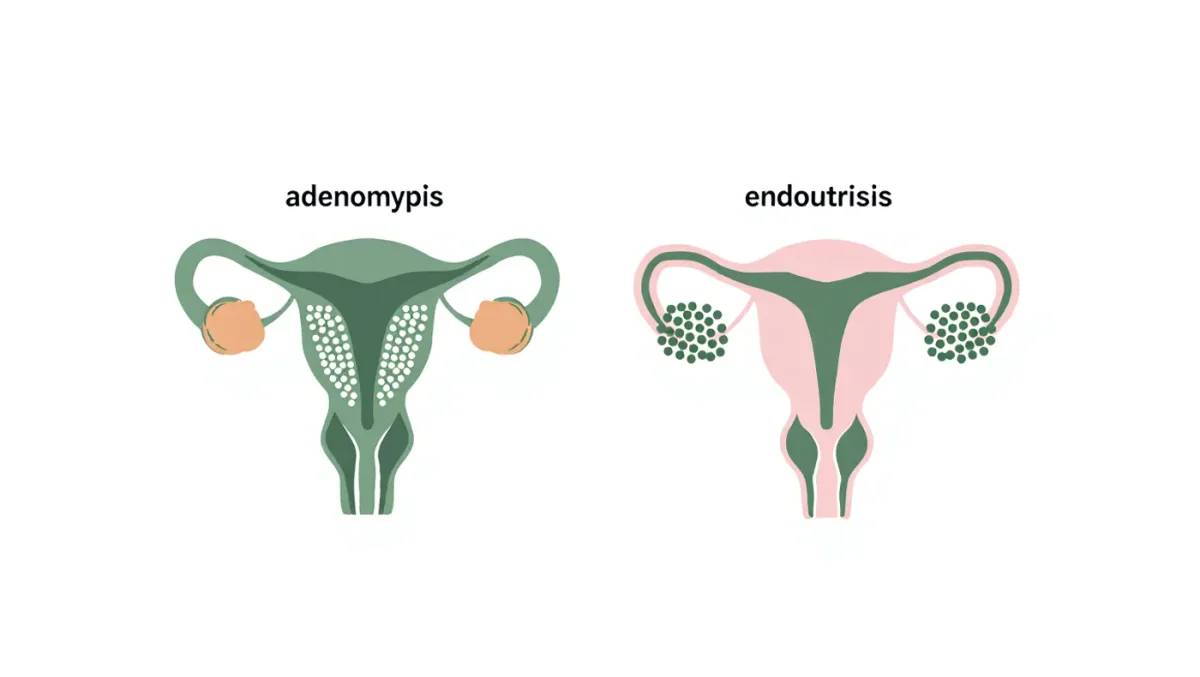
Adenomyosis and endometriosis are related but distinct conditions: adenomyosis is endometrial-like tissue growing inside the muscular wall of the uterus itself, while endometriosis is similar tissue growing outside the uterus — on the ovaries, fallopian tubes, or pelvic lining. Both cause pain and heavy bleeding, both are hormone-driven, and both are underdiagnosed — but they differ in where the tissue sits, how they are imaged, how they are treated, and whom they tend to affect.
This article publishes information, not medical advice. It compares the two conditions side by side, explains where the diagnostic evidence stands, and describes the treatments clinical guidance documents — as background for a conversation with your own clinician, not a substitute for one.
What is adenomyosis?
Adenomyosis is a condition in which tissue resembling the uterine lining grows within the myometrium, the muscular wall of the uterus. With every cycle, this misplaced tissue responds to hormones, thickening and bleeding inside the muscle wall — which swells the uterus, often symmetrically, and drives the condition's signature symptoms: heavy menstrual bleeding and cramping pain that many patients describe as heavier and more diffuse than ordinary period pain. The uterus itself may become enlarged and tender, per the NIH's Eunice Kennedy Shriver National Institute of Child Health and Human Development (NICHD), which notes the condition is most often diagnosed in people in their 40s and early 50s, typically after years of symptoms.
Prevalence is genuinely uncertain: NICHD notes estimates ranging from about 5 percent to as high as 70 percent, depending on whether researchers count surgical specimens, imaging findings, or symptoms — a spread that itself signals how under-recognized the condition has been.
What is endometriosis?
Endometriosis is a condition in which tissue similar to the uterine lining grows outside the uterus — most often on the ovaries, fallopian tubes, and the tissue lining the pelvis — where it bleeds into places with no exit each cycle, causing inflammation, scarring, and adhesions, the scar bands that can bind pelvic organs together. Per the World Health Organization's 2023 fact sheet, it affects roughly 10 percent of reproductive-age women and girls worldwide, about 190 million people. Its hallmark symptoms are painful periods, pain during sex, chronic pelvic pain, and, in a meaningful share of patients, difficulty conceiving — per the American Society for Reproductive Medicine, endometriosis is among the common findings in infertility evaluations.
How do the two conditions differ, side by side?
| Feature | Adenomyosis | Endometriosis |
|---|---|---|
| Location of tissue | Inside the muscular wall of the uterus | Outside the uterus, on pelvic organs and lining |
| Typical age at diagnosis | 40s to early 50s, per NICHD | Reproductive years, often 20s-30s, per WHO |
| Signature symptoms | Heavy, prolonged bleeding; diffuse cramping; enlarged, tender uterus | Cyclical and chronic pelvic pain; pain during sex; bowel pain with periods; infertility |
| Uterus on exam or imaging | Often enlarged, boggy, globular | Usually normal-sized; ovarian cysts (endometriomas) in some |
| Imaging | Pelvic ultrasound and MRI detect many cases | Ultrasound and MRI detect cysts and deep disease; small surface lesions can be invisible |
| Definitive diagnosis | Histology after hysterectomy in many cases | Laparoscopy with visual inspection and biopsy remains the reference standard |
| Hormonal treatment | Overlaps: progestins, hormonal IUS, GnRH-based drugs | Overlaps: same medical options, aimed at pain |
| Definitive surgical option | Hysterectomy, which also ends fertility | Excision of lesions; condition can recur after surgery |
Can you have both at once?
Yes, and the combination is well documented. Because both conditions respond to the same hormonal milieu, they co-occur in a meaningful share of patients — research summarized in a 2018 review in Fertility and Sterility reported that adenomyosis is found alongside endometriosis in a substantial proportion of surgical and imaging series. Coexistence matters practically: a patient whose pain persists after endometriosis surgery, for example, may have adenomyosis contributing symptoms the excision could not reach. It also complicates attribution — which condition is causing which symptom is a question imaging and clinical course answer together, over time.
Why are both so often missed?
Shared reasons, documented across the WHO fact sheet and the specialist literature: severe period pain is normalized rather than investigated; symptoms overlap with common conditions such as irritable bowel syndrome; and the definitive diagnostic tools are invasive, so clinicians and patients reasonably exhaust medical options first. Adenomyosis adds its own wrinkle — for decades it was largely a diagnosis made after hysterectomy, on the removed specimen. High-quality pelvic ultrasound and MRI have changed that, per a 2022 review in the journal Ultrasound in Obstetrics and Gynecology describing standardized ultrasound markers for adenomyosis, but detection still depends heavily on the imager's training and on someone thinking to look.
Related stories: Fibroid Treatment Options, Compared · PCOS: What It Is, and What It Isn't.
How are they treated?
Medical treatment overlaps substantially, per ACOG guidance on both conditions: hormonal options — combined contraceptives, progestins, the levonorgestrel intrauterine system, and GnRH-based medications — reduce or suppress the hormonal cycling that drives symptoms in both conditions, while they are used. Nonsteroidal anti-inflammatory drugs address pain during flares.
Surgery is where the paths divide. For adenomyosis, per NICHD and ACOG, hysterectomy is the definitive treatment — removing the uterus removes the affected wall entirely and ends both fertility and the possibility of recurrence; uterus-sparing procedures exist but are less established. For endometriosis, per ACOG, laparoscopic excision or ablation of lesions can reduce pain and improve fertility chances in selected patients, while the uterus and ovaries are preserved — and recurrence after surgery is documented, which is why hormonal maintenance is often recommended afterward. Pregnancy planning shapes the choice in both conditions, differently in each.
Do these conditions affect fertility?
Endometriosis has the clearer documented association: per the American Society for Reproductive Medicine, it is found in a notable share of infertility evaluations, with mechanisms including distortion of pelvic anatomy, inflammation, and effects on egg quality, and treatments ranging from surgery to in vitro fertilization depending on severity. Adenomyosis's fertility impact is less settled — reviews have associated it with reduced implantation and pregnancy chances, particularly in assisted reproduction, but per the 2018 Fertility and Sterility review the evidence base is thinner and confounded by coexisting endometriosis. No statement here predicts any individual outcome; both conditions leave many people fully able to conceive.
When to talk to a clinician
Seek an evaluation, per the general direction of ACOG guidance, if periods are heavy enough to soak through protection hourly or last longer than a week; if pain limits work, school, or exercise, or does not respond to standard pain relievers; if pain during sex is new or worsening; if you have difficulty conceiving after a year of trying, or six months at 35 or older; or if you notice a change in bleeding pattern alongside fatigue, which can signal iron deficiency anemia. Ask specifically whether adenomyosis as well as endometriosis has been considered — naming both conditions changes what imaging gets ordered. Sudden severe pelvic pain needs same-day evaluation.
Two conditions, one shared signature — pain and heavy bleeding — sorted mostly by geography: inside the muscle wall versus outside the uterus.
Frequently asked questions
Is adenomyosis the same as endometriosis? No. The tissue is similar in both, but its location differs: adenomyosis sits within the uterine muscle wall; endometriosis sits outside the uterus on pelvic organs and surfaces. They differ in typical age at diagnosis, imaging findings, and definitive treatment, per NICHD, WHO, and ACOG guidance. They overlap in symptoms and medical treatment, and they can co-occur in the same patient.
Does adenomyosis always require hysterectomy? No. Hysterectomy is the definitive cure described in NICHD and ACOG guidance, because the condition lives in the uterine wall — but hormonal treatments, including the levonorgestrel intrauterine system and GnRH-based medications, control symptoms for many people, sometimes for years. The decision weighs symptom severity, response to medical therapy, and whether childbearing is complete. Waiting and treating medically is a documented, legitimate path.
Can ultrasound see both conditions? It can see much of both, with limits. Expert pelvic ultrasound detects many adenomyosis features and can identify ovarian endometriomas and deep endometriosis, per a 2021 international consensus statement in Ultrasound in Obstetrics and Gynecology; small surface endometriosis lesions and subtle adenomyosis can be invisible. MRI adds detail in selected cases. A normal scan does not exclude either condition — clinical course remains part of the diagnosis.
Do these conditions raise the risk of cancer? Neither condition is considered precancerous. Adenomyosis is benign, per NICHD, and endometriosis is likewise benign in the overwhelming majority of cases. Research has explored a modest association between endometriosis and certain ovarian cancers, reported in large cohort studies, but per ACOG and WHO guidance the absolute risk remains low and does not change routine management for most patients. This is not a reason for surveillance beyond standard care.
Will symptoms stop at menopause? For both conditions, largely yes — because both depend on cyclic estrogen, and per NICHD and WHO, symptoms typically improve after menopause, when hormone production falls. Hormone therapy after menopause can occasionally reactivate symptoms, per clinical guidance. Until menopause arrives, treatment is about managing the years in between — which is exactly what the medical options in this article exist to do.