
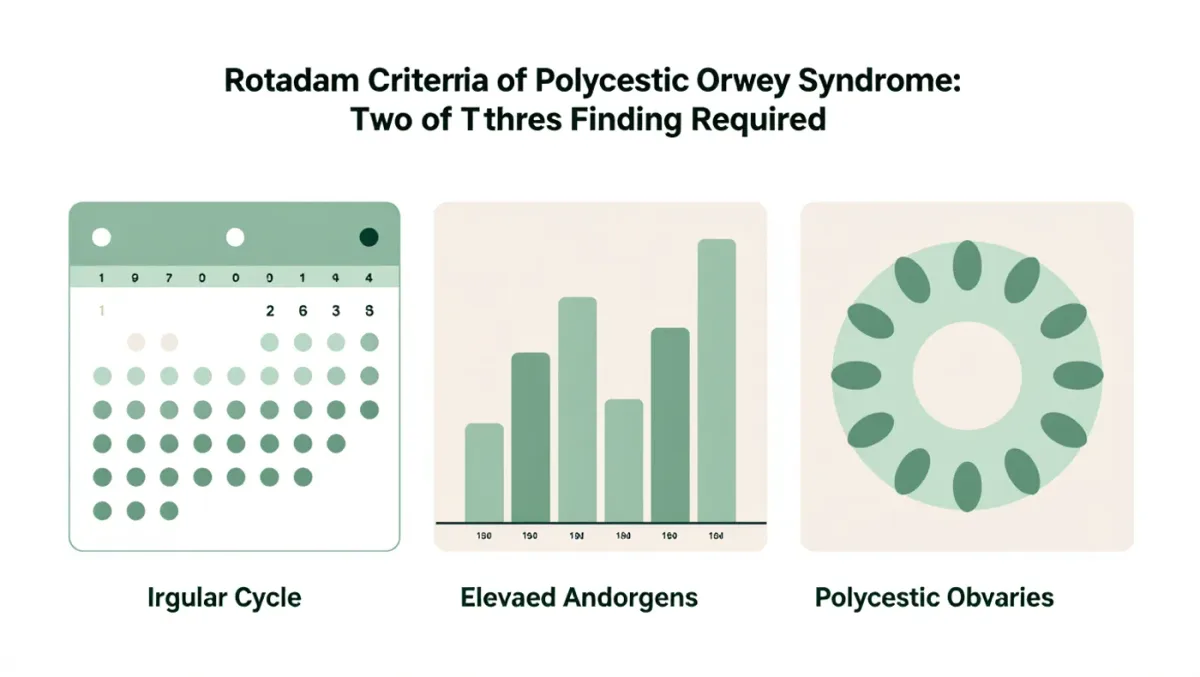
Polycystic ovary syndrome (PCOS) is a common hormonal condition defined by a pattern of findings — irregular ovulation, elevated androgen hormones, and a particular ovarian appearance on ultrasound — not by a single blood test, and it affects an estimated 8 to 13 percent of reproductive-age women, with up to 70 percent of cases undiagnosed, per the World Health Organization's 2023 fact sheet. It is manageable, it is not anyone's fault, and it is not what most people picture when they hear the word "cysts."
This article publishes information, not medical advice. It walks through what the diagnostic criteria actually say, clears up several persistent myths, and describes the treatments clinicians use, so you can go into any appointment with accurate language. For decisions about your own health, work with a qualified clinician.
What exactly is PCOS?
Polycystic ovary syndrome is a condition in which the ovaries or other hormone-producing tissues produce more androgens — hormones such as testosterone that are typically higher in males but present in everyone — alongside irregular or absent ovulation. The name is partly historical accident: the ultrasound appearance that gave the condition its name involves many small, immature follicles around the ovarian edge, not cysts in the sense of growths that need removal.
The diagnostic standard used in most of the world is the Rotterdam criteria, agreed by the European Society of Human Reproduction and Embryology and the American Society for Reproductive Medicine in 2003: a diagnosis requires at least two of three findings — infrequent or absent ovulation, clinical or laboratory signs of high androgens, and the polycystic ovarian appearance on ultrasound — after other conditions that mimic PCOS, such as thyroid disease and elevated prolactin, have been ruled out.
Why is PCOS so often missed?
The World Health Organization's estimate that up to 70 percent of cases go undiagnosed reflects several documented reasons. Symptoms vary so much that no single presentation defines the condition: some people come in for irregular periods, others for acne or unwanted hair growth, others only when trying to conceive. Irregular cycles are often treated with a hormonal contraceptive prescription without an underlying evaluation, which regulates the bleeding pattern while leaving the question of why open. And normal-weight patients are frequently told they cannot have PCOS — which is false, a myth the evidence does not support.
What PCOS is not
- It is not caused by a person's choices. The underlying biology involves genetic predisposition and insulin action; research published in Nature Genetics in 2018 identified multiple genetic risk regions, several tied to gonadotropin and insulin signaling pathways. No one develops PCOS by eating wrong or failing to exercise.
- It is not guaranteed infertility. PCOS is a leading cause of anovulatory infertility, per the American Society for Reproductive Medicine, meaning the issue is frequently that ovulation is not happening regularly — which treatments can often address. Many people with PCOS conceive, with or without assistance. No outcome can be promised for any individual, but the condition does not mean pregnancy is off the table.
- It is not only about the ovaries. PCOS is a whole-body metabolic condition for many patients. Insulin resistance — a state in which the body's cells respond less effectively to insulin — is common, and the Endocrine Society's 2013 guideline on diagnosis and treatment of PCOS notes increased risks of glucose intolerance and type 2 diabetes in affected patients, alongside cardiovascular risk factors that deserve attention over time.
- It is not cured by pregnancy, a supplement, or a single diet. There is no established cure, per the World Health Organization's 2023 fact sheet. Management is ongoing and symptom-directed.
How is PCOS managed?
Treatment targets the symptoms that matter to the patient, described across the Endocrine Society's 2013 guideline and ACOG guidance.
- Irregular cycles. Combined hormonal contraceptives are commonly used to regulate bleeding patterns and reduce androgen effects such as acne.
- Metabolic features. Lifestyle approaches to diet and activity are supported as reasonable first steps, and metformin is used for metabolic and glucose abnormalities, per the Endocrine Society guideline — as an attributed treatment option, not a universal prescription.
- Fertility. For patients trying to conceive, ovulation induction with letrozole has evidence behind it: a large randomized trial published in the New England Journal of Medicine in 2014 (the PPCOS II trial) found letrozole more effective than clomiphene for ovulation and live birth in PCOS patients. That is a study finding, not a promise about any individual.
- Hair and skin symptoms. Anti-androgen medications and dermatologic treatments are options some clinicians use for hirsutism and acne, discussed case by case.
Which combination fits depends on symptoms, pregnancy goals, and other health factors — a conversation for you and your clinician, not a menu to self-prescribe from.
Related stories: Birth Control Options, Beyond the Pill · Adenomyosis vs Endometriosis.
Does weight loss cure PCOS?
No, and the framing matters. Research shows that modest weight reduction, where weight loss is a goal a patient and clinician set together, can restore ovulation in some patients with PCOS and improve metabolic measures — this has been reported in trials such as studies of lifestyle intervention in PCOS summarized by the Endocrine Society guideline. But improvement of features is not the same as cure, weight is not the whole story — normal-weight patients have PCOS too — and weight-centered messaging has left many patients underdiagnosed and under-treated. The condition's biology, including its genetic roots described in the 2018 Nature Genetics research, does not disappear with a change in habits.
Does everyone with PCOS have cysts?
No. This is the most common naming confusion in reproductive health. The "polycystic" appearance refers to a pattern of small follicles seen on ultrasound, and per the Rotterdam framework it is only one of three criteria — two are required. A patient can meet the criteria without that ovarian appearance, and the appearance alone, without symptoms or hormonal findings, does not make a diagnosis. The name also causes needless alarm: follicles are normal ovarian structures, not abnormal growths.
When to talk to a clinician
Consider an evaluation, per the general direction of the Endocrine Society and ACOG guidance, if you have cycles more than 35 days apart or fewer than about eight periods a year; signs of elevated androgens such as new or worsening acne, or coarse hair growth on the face, chest, or abdomen; difficulty conceiving after a year of trying, or six months if you are 35 or older; or a family history of PCOS or type 2 diabetes alongside irregular cycles. Seek care promptly for sudden severe pelvic pain, which has causes beyond PCOS and needs urgent assessment.
A PCOS diagnosis works best as a starting point for organized, ongoing care — not as a label that ends the conversation.
Frequently asked questions
Is PCOS the same as having ovarian cysts? No. The ultrasound finding in PCOS is a ring of small follicles — normal ovarian structures that did not reach full maturity — not cysts. Follicles appear in the condition's name for historical reasons, per the Rotterdam criteria framework. True ovarian cysts are a separate matter, and having them does not mean you have PCOS.
Can thin women have PCOS? Yes. Although insulin resistance is more common at higher body weights, per the Endocrine Society's 2013 guideline, PCOS occurs across the full weight range, and the diagnostic criteria make no weight requirement. Lean patients frequently report longer delays to diagnosis precisely because the myth persists that the condition requires overweight.
Does PCOS go away after menopause? The reproductive features change with menopause because ovulation ends, but per the Endocrine Society guideline, metabolic features such as diabetes risk remain relevant after the reproductive years. Management shifts focus over time. This is another reason the condition is best framed as long-term and manageable rather than something to wait out.
Should everyone with PCOS take metformin? That is an individual clinical decision. The Endocrine Society's 2013 guideline describes metformin as useful for metabolic and glucose abnormalities in PCOS, not as a mandatory universal treatment. Whether it fits your situation depends on glucose results, symptoms, and goals — questions for your clinician, not for self-prescription.
Can you get pregnant with PCOS? Many people with PCOS do get pregnant, with or without fertility treatment; per the American Society for Reproductive Medicine, the condition often affects ovulation, which medical treatments can address. No individual outcome can be promised. If pregnancy is a goal, a fertility-oriented conversation with a clinician is a reasonable early step rather than a last resort.