
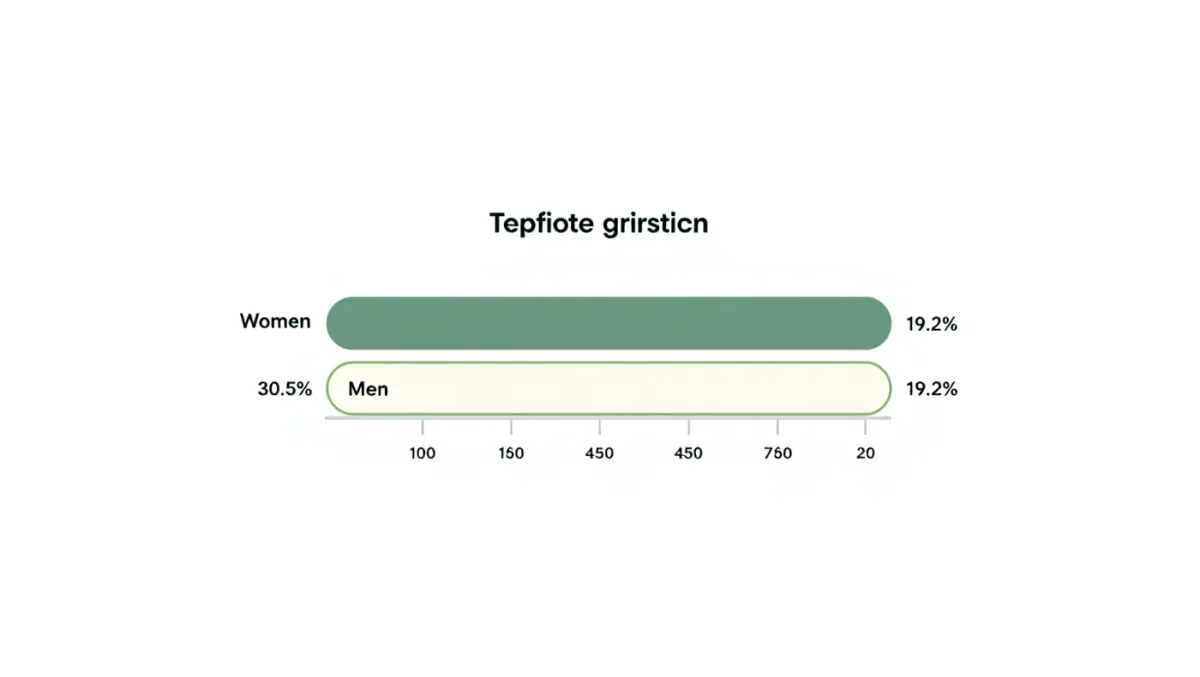
The numbers are consistent across decades: women are diagnosed with depression at roughly twice the rate of men — the World Health Organization puts the excess at about 50 percent globally — and anxiety disorders show a similar gap, with the National Comorbidity Survey Replication, published by Kessler and colleagues in Archives of General Psychiatry in 2005, finding lifetime anxiety disorder in 30.5 percent of US women versus 19.2 percent of men. In 2023 the US Preventive Services Task Force responded with recommendations to screen adults for depression and anxiety, including during pregnancy and the postpartum period.
This site publishes information, not medical advice. Here we walk through what the epidemiology actually documents — and what a positive screen means, which is a conversation with your own clinician, not a diagnosis on its own.
How large is the gap, really?
It depends on the condition and the measure, but it is never small. For depression, the WHO's estimates put lifetime prevalence among women about 50 percent higher than men worldwide; US survey data from the National Institute of Mental Health show past-year major depressive episodes higher in adult women than men by a similar margin. For anxiety, the National Comorbidity Survey Replication's 2005 findings — 30.5 percent of women versus 19.2 percent of men for lifetime anxiety disorders — extend across the specific disorders, with generalized anxiety disorder, panic disorder, and specific phobias each more common in women. PTSD shows one of the widest gaps: per the National Center for PTSD, women are about twice as likely as men to develop posttraumatic stress disorder, despite similar exposure to traumatic events overall.
| Condition | Women | Men | Source |
|---|---|---|---|
| Lifetime anxiety disorder | 30.5% | 19.2% | National Comorbidity Survey Replication, 2005 |
| Depression prevalence | About 50% higher than men | Reference | World Health Organization |
| PTSD in a given year | Roughly twice men's rate | Reference | National Center for PTSD |
| Postpartum depression symptoms | About 1 in 8 recent births | Not comparable | CDC PRAMS |
Why are rates higher in women?
Researchers point to a layered explanation rather than a single cause. Hormonal fluctuation plays a documented role in specific syndromes — perinatal mood disorders and premenstrual dysphoric disorder, a severe cyclic mood condition affecting an estimated 2 to 3 percent of menstruating women per ACOG's guidance, both track hormone swings. Social factors carry weight in WHO analyses: women worldwide carry more caregiving burden, more economic disadvantage, and higher rates of gender-based violence, all established depression risk factors. Trauma exposure patterns differ too — per the National Center for PTSD, the kinds of trauma women more often experience carry higher PTSD risk per event. What the numbers cannot yet do is apportion these contributions precisely; researchers continue to debate how much of the diagnostic gap reflects true difference versus greater willingness to report and seek help.
What do the numbers show about pregnancy and postpartum?
The perinatal period has its own well-documented numbers. Per CDC's PRAMS surveillance, about one in eight women with a recent live birth report postpartum depression symptoms, and perinatal depression — depression during pregnancy or after delivery — affects a similar range per ACOG's 2023 clinical practice guideline. Screening has accordingly tightened: ACOG's guidance recommends screening for depression and anxiety at least once during the perinatal period, and the USPSTF's 2023 recommendation in JAMA extends anxiety screening to asymptomatic adults, including pregnant and postpartum people, explicitly citing women's higher prevalence. The Task Force noted that screening alone is not treatment — it identifies people for whom a fuller diagnostic conversation is warranted.
Related stories: Why thyroid disorders are so much more common in women · How hormones trigger migraines in women.
What does a screening result actually mean?
A positive screen is a flag, not a diagnosis. The instruments the USPSTF endorsed — questionnaires such as the PHQ-9 for depression and the GAD-7 for anxiety — measure symptom load over the past two weeks; they are designed to decide who needs a clinical evaluation, not who has a disorder. Per the Task Force's 2023 statements, clinicians then confirm or exclude the diagnosis, assess severity and safety, and match care accordingly — therapy, medication, or both, depending on severity and preference. Cognitive behavioral therapy has the strongest evidence base for mild-to-moderate anxiety and depression per ACOG's perinatal guidance, with selective serotonin reuptake inhibitors an option where symptoms warrant, including during pregnancy after individualized risk discussion. None of these decisions is made by a questionnaire score alone.
Are women getting the care the numbers suggest they need?
Not fully, per the surveillance data. CDC researchers have reported that a substantial share of women who screen positive for postpartum depression never receive follow-up care, and national surveys have long shown that most adults with mental health conditions receive no treatment in a given year, per NIMH data. Barriers are practical — cost, time, childcare, clinician availability — and attitudinal: per WHO analyses, stigma and normalizing of chronic distress delay help-seeking in both sexes, often longer in women whose symptoms are read as stress or personality. The 2023 screening recommendations are, in part, a policy answer to exactly this gap between prevalence and treatment.
When to talk to a clinician
Consider an evaluation if low mood, loss of interest, worry, or physical tension have persisted for two weeks or more, if sleep, concentration, or appetite have changed without explanation, if you are pregnant or recently gave birth and notice mood changes beyond the early days, or if anxiety is narrowing what you are willing to do. Seek help urgently — same day — for thoughts of self-harm or of harming anyone else; in the United States, calling or texting 988 reaches the Suicide and Crisis Lifeline at any hour. Persistent distress that still functions is also a valid reason for an appointment; the numbers above are precisely why clinicians take it seriously.
Frequently asked questions
Is depression in women linked to hormones? Partly, and the strongest evidence concerns specific syndromes rather than depression overall. Perinatal depression and premenstrual dysphoric disorder — which ACOG's guidance estimates affects 2 to 3 percent of menstruating women — are tied to hormonal fluctuation by their timing and their treatment responses. But per WHO analyses, social factors such as violence exposure, caregiving load, and economic disadvantage explain a large share of the overall gap, so hormone-based explanations alone understate the picture.
Why did the USPSTF add anxiety screening in 2023? Because the evidence had matured. The Task Force's 2023 recommendations in JAMA, based on a systematic review of trials, found adequate evidence that screening adults under 65 — including pregnant and postpartum people — can identify anxiety disorders and that treatment of screened cases improves outcomes. The higher prevalence in women, documented since the 2005 National Comorbidity Survey Replication, was part of the rationale. Screening applies to adults without symptoms; anyone with symptoms is already beyond the screening question.
Can postpartum depression start months after birth? Yes. Per ACOG's 2023 clinical practice guideline, perinatal mood disorders can emerge during pregnancy or at any point in the first year after delivery, which is why the guideline recommends a full assessment of mood and emotional well-being at the comprehensive postpartum visit and continued attention beyond it. About one in eight women with recent births report depressive symptoms per CDC's PRAMS data, and delayed onset follows the same biology as early onset — it is not a different condition.
Are women overdiagnosed, or men underdiagnosed? Both effects have evidence behind them, and researchers have not settled the balance. Per the National Center for PTSD and other reviewers, men underreport symptoms and seek help less, which likely shrinks male prevalence figures; meanwhile some analyses suggest clinicians attribute somatic complaints in women to emotional causes more readily. What is not in dispute is the direction of the documented gap or the finding, per NIMH, that most adults with these conditions — of both sexes — receive no treatment in a given year.