
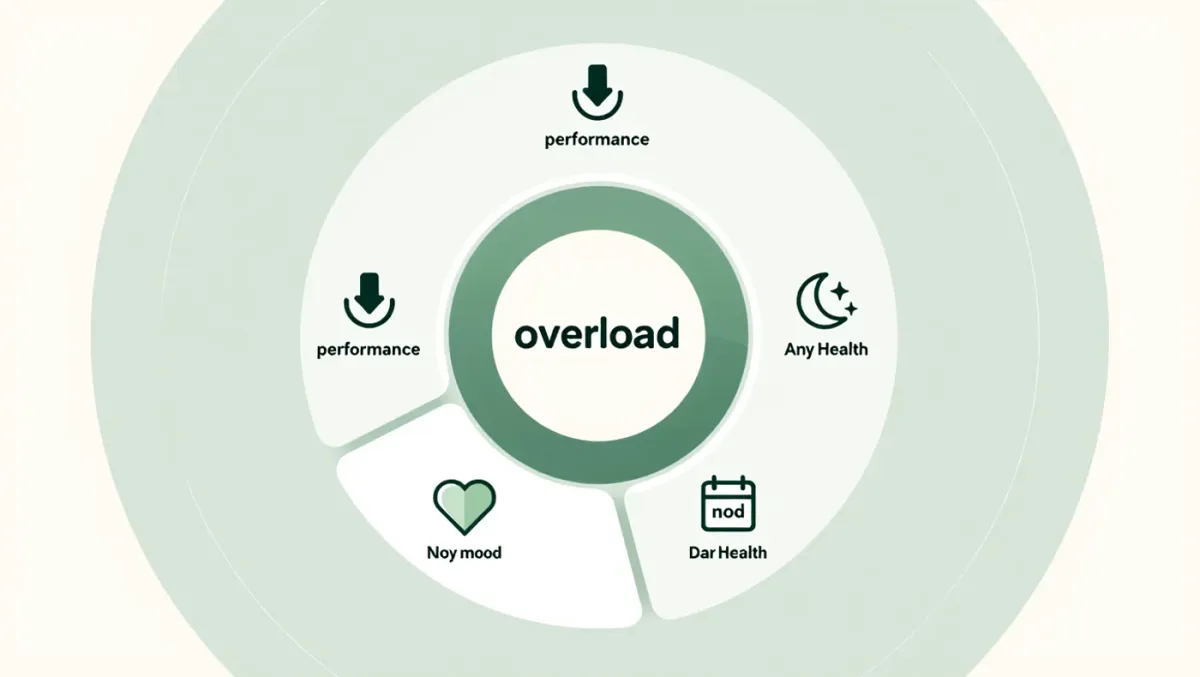
The clearest sign of overtraining is paradoxical: performance keeps falling while training keeps rising — fatigue that rest does not touch, per the description of overtraining syndrome in sports-medicine literature. For women, the International Olympic Committee's consensus work adds two early clinical markers to watch: menstrual dysfunction and bone stress injuries, both linked to training loads that outpace energy intake.
This article publishes information, not medical advice. It explains what overtraining and related conditions are, and how the research describes recovery; it is not a diagnostic tool, and the symptoms below overlap with thyroid disease, depression, anemia, and other treatable conditions — which is exactly why they warrant a clinician rather than self-diagnosis.
Terminology first, because it matters for severity. Overreaching is short-term fatigue from a hard training block that resolves with days to weeks of recovery; overtraining syndrome is a longer-lasting state of maladaptation in which performance and health stay depressed for weeks to months despite rest, as distinguished in ACSM and IOC documents. The body is not being lazy — it is failing to adapt.
What are the recognized signs?
Sports-medicine reviews describe a consistent cluster. On the physical side: declining performance despite maintained or increased training, unusually persistent muscle soreness, elevated resting heart rate in some people, frequent minor illnesses suggesting suppressed immunity, disrupted sleep despite exhaustion, and unexplained weight or appetite changes. On the psychological side, documented mood changes include irritability, loss of motivation, and low mood — several reviews note mood disturbance can precede measurable performance decline, which makes it a signal worth taking seriously rather than pushing past.
For women specifically, the IOC consensus on relative energy deficiency in sport (REDs), updated in 2023 in the British Journal of Sports Medicine, names the clinical consequences of chronic under-fueling against training load: menstrual dysfunction including missed periods, reduced bone density with stress-fracture risk, impaired immunity, and effects on mood and cognition. REDs is the modern framing that grew out of the earlier female athlete triad model, and it applies to recreational exercisers as well as elites — the dose threshold is individual, not an athletic-card requirement.
| Signal | What it may indicate |
|---|---|
| Performance falling despite rising training | Overreaching, progressing to overtraining syndrome if unaddressed |
| Missing or irregular periods | Menstrual dysfunction — a clinical marker of low energy availability (IOC REDs consensus) |
| Focal bone pain worsened by impact | Possible bone stress injury — warrants clinical evaluation |
| Persistent poor sleep, low mood, irritability | Documented features of overtraining; also overlap with medical conditions |
| Frequent minor infections | Described immune suppression in overreaching/overtraining literature |
Why does this happen?
The central mechanism in the modern literature is energy availability: the calories left for basic body functions after training's cost is subtracted. When intake chronically falls short of training's demands — whether through deliberate restriction, busy schedules, or appetite that fails to track exercise — the body reduces spending on systems it deems optional. Reproduction is first in line: the IOC consensus describes suppressed reproductive hormones as a primary consequence, with downstream effects on bone, because bone remodeling depends on those hormones. This is why in women the menstrual cycle functions as a monthly report on fuel adequacy — its disappearance is information, not an inconvenience of athleticism.
Under-fueling is not the only route; inadequate recovery between genuinely well-fueled sessions, illness, and life stress contribute, and the reviews treat overtraining as multifactorial. But the energy-availability pathway is the best-specified one, and the most reversible.
Related stories: Stretching and mobility: what the evidence actually supports · Training around your cycle: what the evidence actually supports.
What does recovery involve?
The unglamorous truth in every sports-medicine account is that recovery means rest, time, and fuel — in that order of certainty. Short-term overreaching typically resolves with days to about two weeks of reduced training, per ACSM descriptions; full overtraining syndrome can take weeks to months, with no medication that substitutes for the reduction. In REDs, the IOC consensus centers recovery on restoring energy availability — increased intake and reduced expenditure — with return to full training guided clinically, and bone recovery measured over months to years, not weeks. Psychological support is part of documented recovery where restriction is driven by disordered eating, which the consensus treats as a medical dimension rather than a discipline problem.
When to talk to a clinician
See a clinician — not just a coach — when performance falls despite rest weeks, when any menstrual period goes missing for three months or cycles become irregular after training changes, when focal bone pain appears, when weight drops without intention, or when exhaustion, low mood, and poor sleep persist beyond a hard training block. These symptoms require exclusion of medical causes: thyroid dysfunction, iron-deficiency anemia — common in menstruating women, per CDC data on iron deficiency — depression, and other conditions can each imitate overtraining. A sports-medicine physician or a knowledgeable primary care clinician is the right entry point, and dietitians with sports credentials handle the fueling side.
Frequently asked questions
Is overtraining the same as being tired from hard training?
No. Functional fatigue after hard sessions resolves with normal recovery and is part of how training works; overreaching is a deliberate short block of that fatigue; overtraining syndrome is when weeks pass, training eases, and performance stays depressed. The ACSM and IOC descriptions emphasize the defining feature: rest that normally restores no longer does. Distinguishing the three is a clinical and coaching judgment, not a single test.
Can I lose my period from exercising too much?
Yes — exercise-associated menstrual dysfunction is a recognized clinical finding, and the IOC's REDs consensus identifies chronically low energy availability as a principal driver, through suppression of reproductive hormones. It occurs in recreational exercisers, not only elites. Missing periods are not a harmless convenience: the same hormonal suppression affects bone density, which is why the finding warrants clinical evaluation rather than training adjustments alone.
How long does overtraining recovery take?
It depends on depth. Sports-medicine descriptions place overreaching recovery at days to about two weeks with reduced load, while established overtraining syndrome can take weeks to months, and REDs-related bone deficits recover over longer horizons measured in months to years, per the IOC consensus. There is no pharmacological shortcut in the literature — the documented levers are load reduction, restored energy availability, sleep, and time.
Who is most at risk?
The documented risk pattern includes people in weight-sensitive sports, those combining high training volumes with restrictive eating, and anyone in a steep training ramp — with the IOC consensus noting that low energy availability affects women's reproductive and bone health earliest and most visibly. Recreational athletes training for events while dieting are a common real-world case. Risk is about the match between fuel and load, not the badge of competitiveness.