
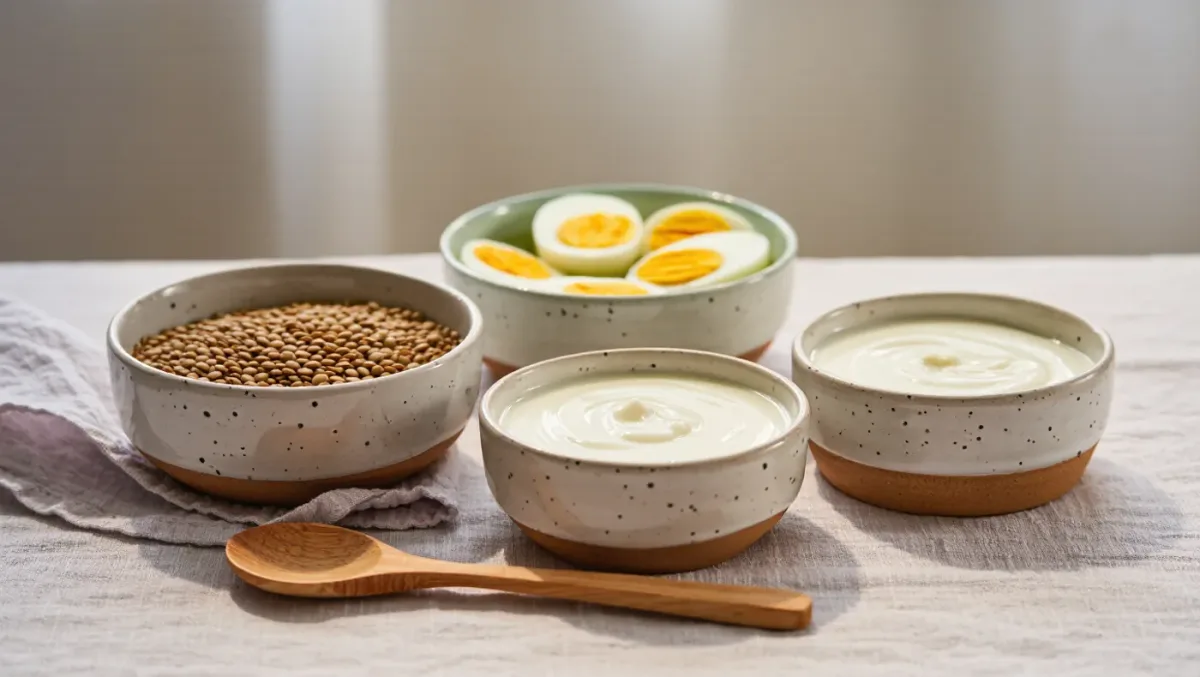
How much protein an active woman needs depends on which number you are asking about: the recommended dietary allowance set by the National Academies — 0.8 grams per kilogram of body weight per day, cited by NIH — covers minimum needs for most sedentary adults, while the joint position stand of the American College of Sports Medicine, the Academy of Nutrition and Dietetics, and the Dietitians of Canada (2016) puts the range for people who train at roughly 1.2 to 2.0 grams per kilogram per day.
This article publishes information, not medical advice. It explains what the official figures mean, where the higher ranges come from, and what the research does and does not show; it is not a diet prescription, and kidney disease, pregnancy, and other conditions change the arithmetic in ways a clinician should arbitrate.
Protein is worth the care because its job is structural. Dietary protein supplies amino acids — the building blocks the body uses to build and repair muscle, bone matrix, enzymes, and immune components — and muscle is in constant turnover, breaking down and rebuilding in response to activity. Training raises the rebuild side of that equation, which is the entire logic behind higher intakes for active people.
Why does the RDA seem low?
Because it answers a different question. The 0.8 g/kg RDA is the intake estimated to prevent deficiency in most healthy adults — nitrogen balance, not optimization. It was never designed as a performance or healthy-aging target, and the sports-nutrition bodies say so directly: the 2016 joint position stand describes the RDA as below the needs of athletes and recommends the 1.2 to 2.0 g/kg range depending on training type and volume, with the lower end suiting general endurance work and the upper end suiting intense training and calorie restriction.
Age shifts the answer too. The PROT-AGE Study Group, publishing in the Journal of the American Medical Directors Association in 2013, recommended 1.0 to 1.2 g/kg per day for most healthy older adults — above the RDA — on the grounds that older muscle responds less efficiently to the protein eaten. For a woman over 40 who trains, the practical overlap is that both the sports-nutrition and healthy-aging literatures point above 0.8, which is why the RDA keeps generating confusion it was never meant to resolve.
| Population | Attributed intake figure | Source |
|---|---|---|
| Most healthy adults | 0.8 g/kg/day (RDA) | National Academies, cited by NIH |
| People who train | 1.2-2.0 g/kg/day | ACSM/AND/DC joint position stand, 2016 |
| Healthy adults over ~65 | 1.0-1.2 g/kg/day | PROT-AGE Study Group, 2013 |
| Per meal, to maximize muscle protein synthesis | Roughly 0.4 g/kg/meal; higher figures considered for older adults | JISSN position statement, 2018 |
Does timing and distribution matter?
More than the mythology around it suggests, less than supplement marketing implies. The 2018 position statement from the Journal of the International Society of Sports Nutrition describes muscle protein synthesis as responding per-meal, and suggests distributing intake across the day — with roughly 0.4 g per kilogram per meal cited, and somewhat higher per-meal amounts considered for older adults whose muscles respond less sensitively. The heavily promoted 30-minute post-workout anabolic window, by contrast, has softened in the research: the 2016 joint position stand describes total daily protein as the priority, with timing a secondary refinement that matters most when training is fasted or sessions stack close together.
Related stories: Safe core exercise during pregnancy: what the guidance supports · Training around your cycle: what the evidence actually supports.
Does protein protect muscle through midlife?
Adequate intake is one of the two documented levers, the other being resistance training itself. Sarcopenia — the age-related loss of muscle mass and strength, defined in the EWGSOP2 consensus of 2019 — cannot be addressed by protein alone; trials consistently show resistance training as the stimulus, with nutrition supplying the material. The NSCA's 2019 position statement on older adults makes the same pairing: training provides the signal, protein supports the response. Inadequate intake works against both levers, which is why restrictive eating plus hard training is the pattern sports-dietetics bodies flag as risky — a pattern with its own clinical name in extreme forms, relative energy deficiency in sport.
Can you get enough without supplements?
For most people, yes — food covers the attributed ranges without difficulty once portions are considered. Rough orientation from USDA food-composition data: a 3-ounce portion of chicken provides around 25 grams of protein; a cup of Greek-style yogurt around 20; three eggs around 18; a cup of lentils around 18; a cup of firm tofu in the high teens to low twenties. At 60 kilograms body weight, a 1.6 g/kg target is 96 grams daily — reachable with deliberate protein at each meal, which is exactly what the distribution research recommends anyway. Supplements are a convenience for gaps, not a requirement, and the 2016 position stand treats whole-food-first as the default.
When to talk to a clinician
Check with a clinician before raising intake if you have reduced kidney function or diagnosed chronic kidney disease — protein restriction is part of management for some kidney conditions, so the general ranges do not apply. Pregnancy raises protein needs above the standard RDA, per NIH guidance, and is a question for the obstetric team rather than an article. Also worth a conversation: unexplained fatigue with heavy training, menstrual cycles becoming irregular, or stress fractures — these can mark under-fueling rather than under-training, and the IOC's consensus work on relative energy deficiency in sport treats them as clinical signals, not willpower problems.
Frequently asked questions
Will eating more protein make me bulky?
No — protein is a building material, not a growth signal. Substantial muscle gain requires a progressive resistance-training stimulus plus an energy surplus, per the NSCA's 2019 position statement; dietary protein on its own supports repair of what training already demands. Women eating in the attributed 1.2 to 2.0 g/kg range while training normally are replacing turnover and supporting recovery, not adding bulk.
Is plant protein adequate?
Yes, with attention to totals. The 2016 joint position stand evaluates protein by amino acid profile and digestibility rather than by source, and notes that plant-based eaters can meet needs with adequate total intake, since individual plant proteins vary in limiting amino acids. USDA composition data shows lentils, tofu, tempeh, and soy milk in ranges that make daily targets achievable without animal products; variety across the day covers the profile question.
Do I need protein immediately after a workout?
The strict 30-minute window is not supported as written. The 2016 ACSM/AND/DC position stand prioritizes total daily intake, and the 2018 JISSN statement frames per-meal distribution across the day as the operative pattern. Post-training protein still makes sense practically — it is a convenient anchor for a meal the distribution logic wants anyway — but missing it does not forfeit a session's gains.
Can too much protein be harmful?
For healthy people, the attributed evidence does not show harm from intakes within the sports-nutrition range, and the 2016 position stand reviews safety concerns without finding support for them at these levels. Known kidney disease is the exception where intake is a medical question. Very high-protein patterns that crowd out other food groups can shortchange fiber, carbohydrates, and micronutrients — a dietary-quality concern rather than a protein-toxicity one.