
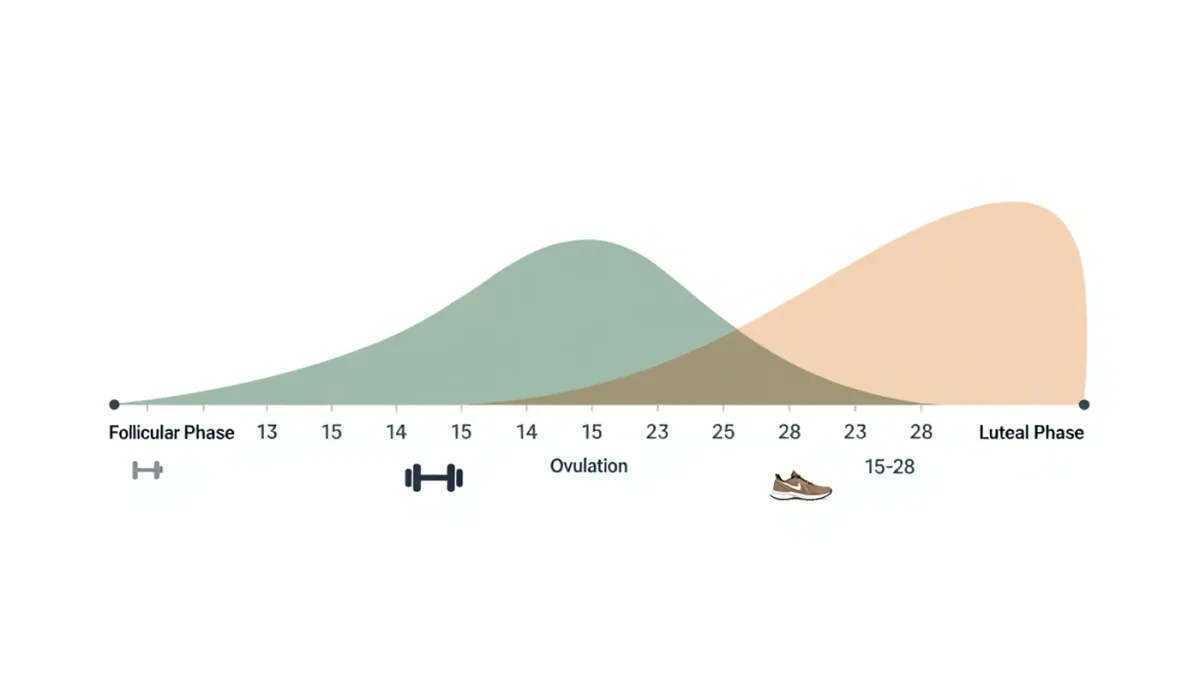
If you have seen a chart telling you to lift heavy after your period and do yoga before it, here is the honest answer: the largest systematic review of the question, published in Frontiers in Sports and Active Living in 2020, found that menstrual cycle phase had only a small effect on exercise performance — and warned that the underlying studies were of low quality, underpowered, and rarely reproduced. Consistency matters more than cycle-timed intensity for most people.
This article publishes information, not medical advice. It summarizes what research and sports-medicine bodies say about exercise and the menstrual cycle; it is not a training prescription, and questions about your own cycle belong with your clinician.
The menstrual cycle is the roughly month-long sequence of hormonal changes that prepares the body for a possible pregnancy. It has two main phases separated by ovulation: the follicular phase, from the first day of bleeding until ovulation, when estrogen rises toward its peak, and the luteal phase after ovulation, when progesterone dominates and body temperature runs slightly higher.
Do hormones change how well you can exercise?
Much less than the phase-training charts imply. The 2020 review by McNulty and colleagues pooled studies measuring strength, power, and endurance across cycle phases and found trivial-to-small differences that were often inconsistent between studies. The authors were explicit about the limits: high risk of bias, small samples, and imprecise hormone verification meant the findings could not support firm recommendations. Since then, sports scientists have repeatedly called for better-designed trials rather than definitive phase-based programming.
What physiology does document is subtler: during the luteal phase, core body temperature is higher and the cardiovascular system works somewhat harder at a given workload, observations summarized in exercise-physiology literature and by the studies McNulty's team reviewed. For a recreational workout, this mostly registers as the same session feeling slightly harder — which is information about the day, not a verdict on the plan.
What actually holds up?
A few conclusions survive contact with the evidence:
- Exercise itself is safe and beneficial across all phases of a normal cycle, per the WHO's 2020 physical activity guidelines, which make no phase-based exception for women of reproductive age.
- Performance variation between phases is small, per the 2020 systematic review — well within ordinary day-to-day fluctuation.
- Some women notice genuine day-to-day variation in energy, comfort, and motivation; tracking it personally is reasonable, as long as the tracking stays descriptive rather than becoming a rulebook.
- For menstrual pain, a 2019 Cochrane review of exercise for dysmenorrhea — the medical term for painful periods — found some studies suggesting benefit but rated the overall evidence as low quality, so exercise is a reasonable option to try rather than a proven treatment.
Is there harm in following a cycle-based plan?
For most people, no — if a chart nudges you toward hard sessions in one week and gentle movement in another, the total workload can still land inside the WHO 2020 targets of 150 to 300 minutes of moderate aerobic activity plus two muscle-strengthening days. The risk is the opposite one: a rigid plan can turn a normal low-energy day into a skipped week, which is a worse trade than simply reducing the session. The WHO guidance is blunt on this point — some activity is better than none.
The comparison that matters is with the alternative people abandon:
| Approach | What the evidence shows |
|---|---|
| Cycle-phase periodized training | Small, inconsistently measured phase effects; low-quality, underpowered studies (McNulty et al., 2020) |
| Fixed weekly routine, adjusted by feel | Meets guideline doses reliably; phase effects treated as minor day-to-day variation |
| Skipping exercise during bleeding or PMS days | No guideline support; WHO 2020 recommends continued activity, scaled down when needed |
Related stories: Stretching and mobility: what the evidence actually supports · Strength training after 40: a realistic place to start.
What about hormonal birth control?
This is where most cycle-training charts quietly stop applying. Combined hormonal contraceptives suppress ovulation and keep hormone levels comparatively steady across the month, which means a pill user does not have the follicular and luteal hormone swings the charts are built on — a point the 2020 review's authors make when they note that contraceptive use changes the very signals phase-based programming claims to exploit. Copper IUDs, which contain no hormones, leave the underlying cycle intact. Research on whether different contraceptive types affect athletic performance remains limited and mixed, so the defensible position is the plain one: if your hormones are suppressed by a method you chose, phase-based plans describe someone else's physiology. The WHO's 2020 activity targets, and the flexibility to scale sessions by how you actually feel, remain the more useful frame.
When to talk to a clinician
Exercise does not require a symptom-free cycle, but certain signs are clinical ones. Talk to a clinician if periods become irregular or stop entirely after training volume increases — exercise-associated menstrual dysfunction is a recognized medical issue, flagged in International Olympic Committee consensus statements on relative energy deficiency in sport, not a sign of being fit. The same applies to pain that interferes with daily life or does not respond to usual measures, bleeding that is dramatically heavier than your norm, or pelvic pain during exercise that is new or one-sided. These have specific, treatable causes, and an article cannot sort them out for you.
Frequently asked questions
Should I lift heavier weights in the follicular phase?
The 2020 systematic review found only small and inconsistent differences in strength across cycle phases, so there is no evidence-based reason to save heavy lifting for a particular week. If you feel strong and recovered, progressive loading in line with general strength-training guidance is reasonable at any point in the cycle. Personal tracking can inform how you schedule sessions without needing phase rules.
Is it safe to exercise during your period?
Yes, for a normal cycle without a diagnosed condition. The WHO's 2020 guidelines recommend regular physical activity for women of reproductive age without restricting it to particular phases, and many people report that light to moderate movement eases cramps — though the Cochrane evidence for exercise as a treatment for painful periods is rated low quality. Any diagnosed condition that changes this belongs in a conversation with your clinician.
Why do workouts feel harder before my period?
The luteal phase, after ovulation, brings slightly higher core temperature and greater cardiovascular strain at a given workload, per exercise-physiology research summarized in the 2020 McNulty review. Sleep disruption and general discomfort in the premenstrual days add to the effect. Feeling the same session as harder is a documented physiological reality, not a fitness loss — reducing intensity for a few days does not undo training.
Does exercise affect cycle regularity?
It can. In athletes and in people whose energy intake does not match training demands, the IOC's consensus work on relative energy deficiency in sport links low energy availability with menstrual dysfunction, including missed periods. Recreational activity within guideline doses is not associated with cycle disruption in typical circumstances, but a newly irregular or absent cycle after increasing training warrants a clinical evaluation rather than self-adjustment.