
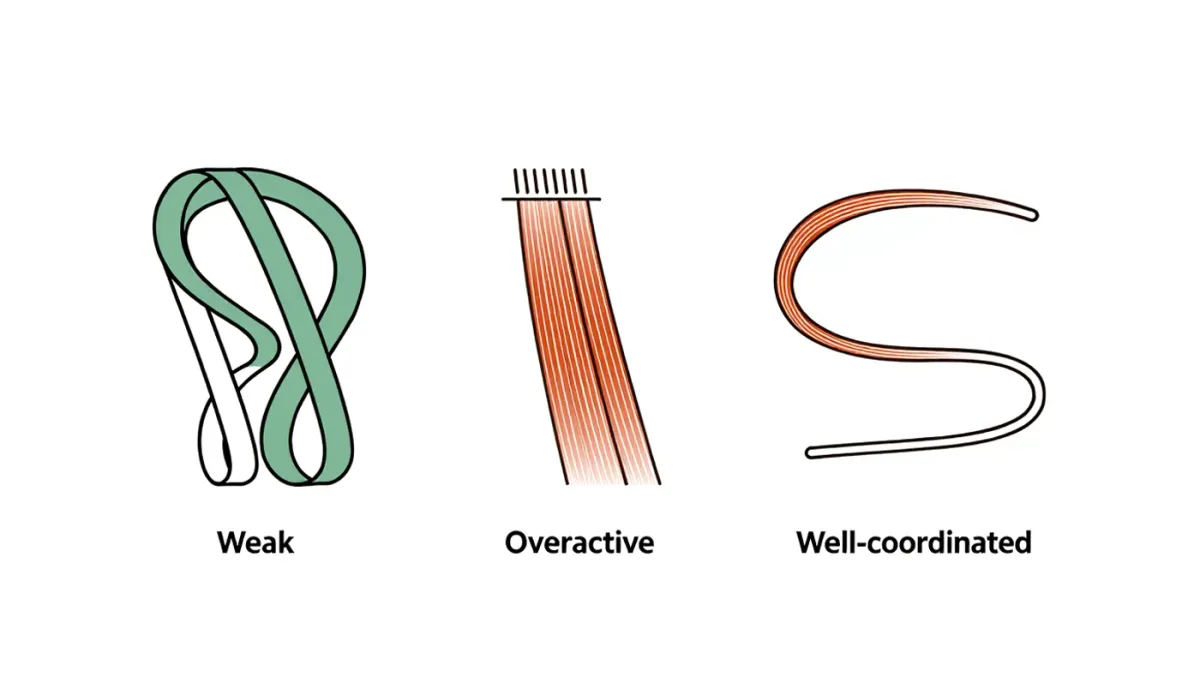
Pelvic floor problems are common and treatable, and Kegels — the squeeze-and-lift exercises named after gynecologist Arnold Kegel in 1948 — are only one tool for one type of problem: roughly one in four US women has at least one pelvic floor disorder, per a 2008 analysis of National Health and Nutrition Examination Survey data published in JAMA, yet doing Kegels blindly can worsen symptoms when the underlying problem is a muscle that is too tight rather than too weak.
This article publishes information, not medical advice. It explains what the pelvic floor does, how overactivity and underactivity differ, what pelvic floor physical therapy involves, and what the evidence supports. Evaluation of symptoms belongs with a clinician — ideally one trained in pelvic medicine.
What is the pelvic floor, and what does it do?
The pelvic floor is a hammock of muscles, ligaments, and connective tissue spanning the bottom of the pelvis. It supports the bladder, uterus, and rectum; controls the openings of the urethra, vagina, and anus; contributes to sexual function; and works with the deep abdominal and back muscles to stabilize the core, per NIH's Eunice Kennedy Shriver National Institute of Child Health and Human Development.
Like any muscle group, it can be weak, overactive — chronically contracted and unable to relax — poorly coordinated, or some combination. The symptoms differ, which is why the correct exercise differs too.
How common are pelvic floor problems?
The best US prevalence data come from the 2008 JAMA analysis by Ingrid Nygaard and colleagues: among 1,961 nonpregnant women in NHANES, 23.7 percent had at least one pelvic floor disorder — urinary incontinence in about 15 percent, fecal incontinence in about 9 percent, and pelvic organ prolapse in under 3 percent. Prevalence rose with age, childbirth history, and body weight.
Pelvic pain and pain with intercourse, which also involve the pelvic floor, add substantially to these numbers and are often undercounted because they go unreported. The common thread across studies is silence: most women with symptoms wait years before mentioning them to anyone.
Why can Kegels be the wrong exercise?
Because two opposite dysfunctions produce overlapping symptoms. A weak, underactive pelvic floor — common after vaginal childbirth and with estrogen decline after menopause — leaks urine with coughs, jumps, and sneezes, and Kegels are genuinely the first-line exercise for it. An overactive pelvic floor — muscles that never fully release — can cause urgency, constipation, painful intercourse, and pelvic pain, and for these people, more squeezing tightens the problem.
A 2018 review in Journal of Bodywork and Movement Therapies and clinical guidance on chronic pelvic pain both describe overactivity as a recognized driver of pain syndromes, treated by learning to lengthen and relax the muscles — the opposite of a strengthening program. Self-diagnosis of which dysfunction you have is unreliable; a trained clinician can feel it.
What is pelvic floor physical therapy?
Pelvic floor physical therapy is a specialty in which a trained physical therapist assesses the muscles directly — often with internal examination — and builds a plan combining several techniques. A typical program may include:
- Biofeedback: sensors that display your muscle activity on a screen, so you learn what a correct contraction — and a correct relaxation — feels like.
- Down-training and relaxation work: breathing mechanics, stretches, and manual techniques for overactive muscles.
- Progressive strengthening: supervised contractions of the right muscles at the right intensity, which corrects the estimated one in three women who do Kegels incorrectly when taught only by verbal instruction.
- Coordination training: timing the pelvic floor to brace before a cough or lift, and release fully afterward.
The evidence for the strengthening arm is strong: a 2020 Cochrane review of 31 trials found pelvic floor muscle training was far more effective than no treatment or sham care for urinary incontinence — women were about eight times more likely to report cure or improvement — with the largest gains in supervised, individualized programs.
Related stories: Alcohol Guidelines for Women, Explained: One Drink, Cancer, and the Heart · Loneliness and Health: What the Research Actually Shows.
Does anything besides exercise matter?
| Factor | Evidence status |
|---|---|
| Supervised pelvic floor muscle training | Strong evidence for urinary incontinence (Cochrane, 2020) |
| Weight loss | A 2010 randomized trial in the New England Journal of Medicine found a 6-month program reduced incontinence episodes about 70 percent more than control |
| Vaginal pessary for prolapse | Established non-surgical option, per ACOG guidance |
| Estrogen therapy after menopause | Improves tissue quality and urinary symptoms in selected women, per the Menopause Society's 2022 position statement |
| Dry needling, yoga, generalized core classes | Early or limited evidence; reasonable adjuncts, not proven therapies |
Childbirth preparation and postpartum care deserve a mention: per ACOG's 2019 guidance on postpartum care, recovery of pelvic floor function is a core postpartum issue, and referral to pelvic floor physical therapy is a recognized option for persistent symptoms — not something to be endured as inevitable.
A note on expectations: improvement is usually measured in weeks, not sessions. The Cochrane review's trials ran three months or longer, and biofeedback studies show skill-building is gradual. A good therapist sets a review point, adjusts the program, and refers onward if progress stalls.
When to talk to a clinician
Bring pelvic floor symptoms to a clinician if you leak urine with activity or urgency, feel pelvic pressure or a bulge, have pain with intercourse or pelvic exams, struggle with chronic constipation, or notice persistent pelvic pain — all are discussable, treatable complaints, not embarrassments to manage silently. Ask specifically whether pelvic floor physical therapy is appropriate for your pattern. Seek care promptly for blood in the urine or stool, sudden inability to urinate, or a bulge that becomes painful or irreducible, which need urgent evaluation.
Frequently asked questions
How do I know whether my pelvic floor is weak or tight? Reliably, you cannot tell by symptoms alone — leakage, urgency, and pelvic pain can each come from either pattern. A pelvic floor physical therapist can assess muscle tone and coordination with an internal examination, per the clinical literature. This is the strongest argument against buying a generic Kegel app and hoping: the first step is diagnosis, not exercise.
Do I need a referral to see a pelvic floor physical therapist? It depends on your state and insurance; in many US states physical therapists have direct access, while some plans require a physician referral, per APTA guidance. Bringing your symptoms to a primary care clinician, OB-GYN, or urogynecologist is a reasonable first step in any case, because they can also rule out conditions that mimic pelvic floor dysfunction.
Can pelvic floor problems be prevented? Partly. Maintaining healthy weight, treating chronic constipation, avoiding persistent heavy lifting with poor technique, and doing correctly supervised strengthening after childbirth are supported by trial evidence, per the Cochrane review's 2020 findings. Age, vaginal childbirth, and genetics remain beyond control — which is exactly why early treatment beats prevention promises sold online.