
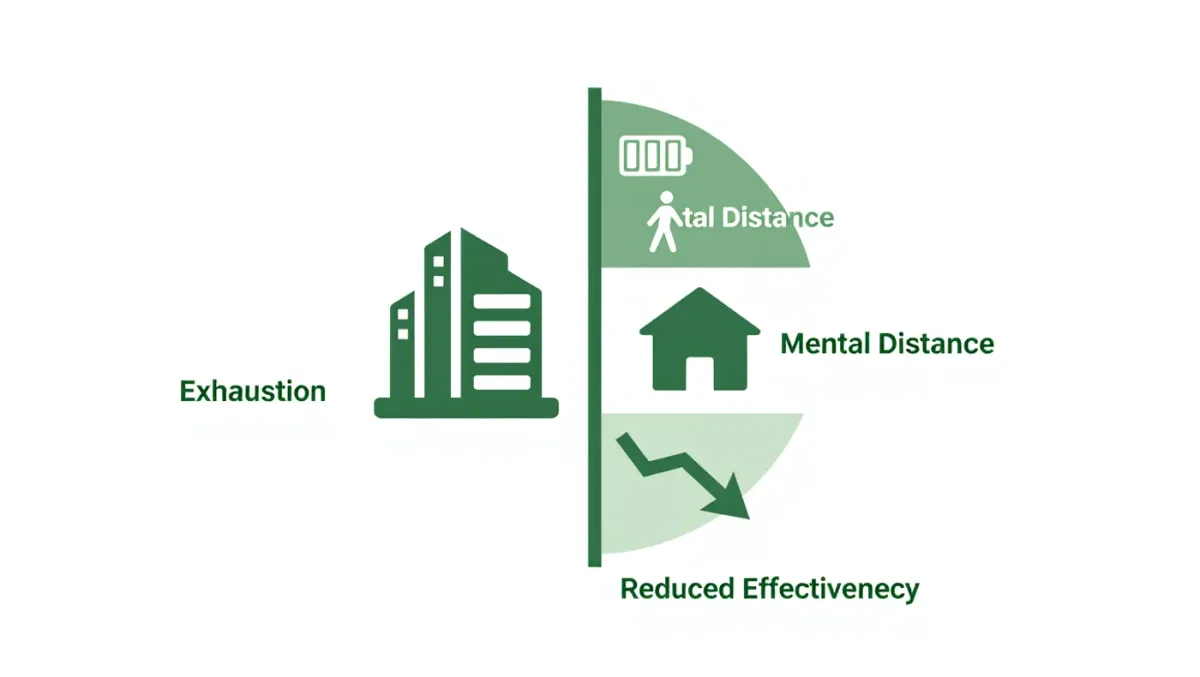
Burnout has a precise official definition, and it is narrower than casual usage suggests: the World Health Organization's ICD-11, adopted in May 2019 and effective January 2022, classifies burnout as an occupational phenomenon — a syndrome resulting from chronic workplace stress that has not been successfully managed — with three dimensions: exhaustion, mental distance or cynicism toward one's job, and reduced professional effectiveness. It is explicitly not a medical condition, and the WHO says so directly. A survey by Gallup in 2018 found about two-thirds of full-time US workers reported experiencing burnout at least sometimes.
This article publishes information, not medical advice. It explains what fits the definition and what does not, how burnout overlaps with depression, what interventions the evidence supports, and when symptoms call for a clinician rather than another productivity hack.
What exactly does the WHO definition include?
Three features, per the ICD-11 text. First, energy depletion or exhaustion — the bone-tired feeling that sleep does not repair. Second, increased mental distance from one's job, or cynicism and negativity about it — the "why does any of this matter" voice. Third, reduced professional efficacy — the feeling of working hard and accomplishing less.
Two boundaries matter. The definition is tied to the workplace: the ICD-11 notes the syndrome refers specifically to phenomena in the occupational context, which is why "burnt out from my family" or "burnout from caregiving" are popular extensions, not clinical uses of the term — the research term for the home version is closer to caregiver burden. And because it is not classified as a disease, burnout cannot be diagnosed like pneumonia can; the three features are described, measured with survey instruments, not found on a lab test.
How is burnout measured?
The dominant instrument is the Maslach Burnout Inventory, developed by Christina Maslach and Susan Jackson in 1981, which scores the same three dimensions the WHO later adopted — emotional exhaustion, depersonalization, and reduced personal accomplishment. Validated for decades, it remains the research standard, alongside newer free instruments such as the Copenhagen Burnout Inventory and the WHO's own short well-being index.
Measurement quality varies widely in media surveys, which is worth remembering when headlines declare burnout rates. National survey figures — Gallup's roughly two-thirds in 2018, for example — count people who say they feel burned out "sometimes," a far lower threshold than meeting all three ICD-11 dimensions chronically. Both numbers are real; they are measuring different things.
Is burnout the same as depression?
No, and the distinction has been studied directly. Research published by psychosomatic researchers in the 2000s and 2010s found substantial overlap in symptoms — exhaustion, low mood, impaired concentration — but meaningful differences: burnout's negativity is anchored to work, while depression colors all domains of life and includes features burnout does not, such as persistently diminished pleasure in everything, hopelessness about the future, and appetite and sleep disruption unrelated to workload. The two can coexist, and severe or persistent burnout-like symptoms justify screening for depression, which is a treatable medical condition.
The practical upshot: an employee whose misery evaporates on vacation likely fits the burnout pattern; someone whose despair follows them onto the beach needs clinical evaluation, not just a schedule change.
What causes it, and who gets it?
The research points to working conditions more than personal fragility. Maslach's six mismatch areas — workload, control, reward, community, fairness, and values — and the prominent role of low autonomy echo the demand-control model of job strain developed by Robert Karasek in 1979, in which high demands combined with low decision-making power produce the most harmful stress. Burnout concentrates in high-demand, low-control, people-intensive work: healthcare, teaching, social services.
Women deserve specific attention here. In high-stress professions, female workers report higher burnout rates in several national studies — researchers have linked this to stacking: the same workplace demands carried alongside a disproportionate household mental load, plus documentation that women's burnout more often includes the exhaustion dimension. These are survey-based associations, consistently directioned but modest in size — honest calibration, not determinism.
Related stories: The Mental Load: What Research Actually Says About the Work Behind the Work · What Science Actually Says About Stress and Cortisol.
What actually works to reduce burnout?
The best-known evidence synthesis is a 2016 meta-analysis by Colin West and colleagues in The Lancet, covering 261 observational studies and 15 interventional trials, largely in physicians: individual-level interventions — mindfulness training, stress-management workshops, small-group programs — produced small, statistically significant reductions in burnout scores, while organizational-level interventions, such as workload changes and schedule redesign, produced larger effects. The conclusion drawn across the literature since: individual coping tools help, but the condition is occupational, and the biggest levers sit with the employer.
| Intervention | Evidence status |
|---|---|
| Organizational changes (workload, staffing, schedules) | Larger effects in the 2016 Lancet meta-analysis; most durable in follow-up studies |
| Individual programs (mindfulness, CBT-based stress management) | Small but significant short-term reductions, per the same synthesis |
| Increased job control and autonomy | Supported by the demand-control research tradition (Karasek, 1979) |
| Vacation and rest alone | Relief is real but temporary; effects decay within weeks in prospective studies |
| Wellness apps as a stand-alone fix | Limited trial evidence; not a substitute for structural change |
For readers without authority over their workload, the evidence-based priorities are the ones with modest trial support: protect sleep, use therapy-based stress management rather than slogans, negotiate for control where possible — and recognize that a job whose design cannot be survived may itself be the diagnosis.
When to talk to a clinician
See a clinician when exhaustion and low mood persist beyond a vacation, when pleasure in everything — not just work — has faded, when sleep, appetite, or concentration are disrupted for weeks, or when you notice drinking more to cope. These patterns may indicate depression or another treatable condition, and screening is quick. Seek help urgently and the same day if you have thoughts of self-harm or hopelessness about living. If symptoms are work-anchored but severe, a clinician can also document limitations for workplace accommodations, which are protected in many settings under disability law.
Frequently asked questions
Is burnout officially a disease now? No. The WHO's ICD-11, effective January 2022, classifies it as an occupational phenomenon, not a medical condition — a decision the organization explained directly when adopting it in 2019. That status shapes practice: no clinical diagnosis of burnout exists in the way depression is diagnosed, and employers' health plans do not treat it as a billable disease, though its consequences can be.
Can you be burned out and not depressed? Yes — the research literature distinguishes them, and many people with work-anchored burnout recover fully in nonwork domains. The overlap is real, though: psychosomatic studies find substantial shared symptoms, which is why persistent burnout-like exhaustion deserves a depression screen rather than self-labeling. When negativity stops at the office door, burnout fits; when it follows you home and stays, get evaluated.
Does a vacation fix burnout? It relieves but does not resolve. Prospective studies find the restorative effects of time off decay within two to four weeks of returning, per occupational-health research — consistent with the WHO's framing of burnout as chronic unmanaged workplace stress. Vacations are maintenance, not repair; the interventions with larger, more durable effects in the 2016 Lancet synthesis changed the structure of the work itself.