
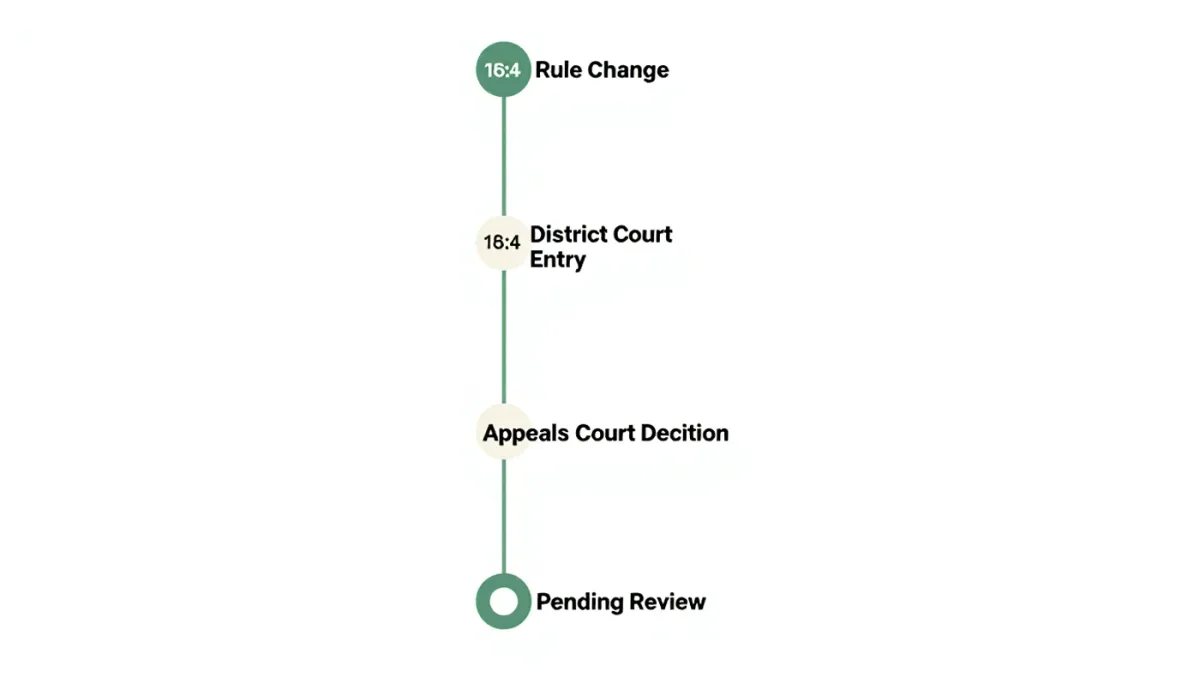
On May 1, 2026, a three-judge panel of the US Court of Appeals for the Fifth Circuit ruled in Louisiana v. FDA that the FDA likely acted unlawfully when it removed the in-person dispensing requirement for mifepristone in 2023, per the panel's opinion. The decision would bar mailing the drug and pharmacy dispensing nationwide and restore in-person pickup. As of this writing in mid-May 2026, the ruling had not taken effect: mifepristone remains available by telehealth and mail while the government seeks further review. This site publishes information, not medical or legal advice.
What the court actually decided
The panel — case number 26-30203 — held that Louisiana was strongly likely to succeed in arguing the FDA's 2023 rule changes were unlawful, per the opinion filed May 1, 2026. Two changes were in dispute: the removal of the requirement that a patient collect the drug in person, and the certification of mail-order pharmacies to dispense it. The court did not rule on the drug's safety in the abstract; it ruled on the legality of how the FDA changed distribution rules, in a suit brought by the state of Louisiana, which classified mifepristone as a controlled dangerous substance under a state law effective October 1, 2024.
Related stories: Women's health venture funding fell to $1.58 billion in 2025 · Title X clinics raced to reapply for funding before the April 1 deadline.
Where the case stood in mid-May
The procedural path matters. On April 7, 2026, a federal district court in Louisiana declined to invalidate the FDA's 2023 changes but paused the case so the agency could complete a safety review, per court filings reported by KFF and SCOTUSblog. The state appealed, producing the May 1 ruling. The government's next step, widely reported by mid-May 2026, was to ask the Supreme Court to block the panel's order while review proceeds — meaning the practical status quo, telehealth and mail access preserved, was holding but explicitly provisional.
What this means for readers
If you use or may need mifepristone — for abortion or for managing a miscarriage, one of its labeled uses — nothing about availability changed in the days after the ruling. Jurisdiction matters, though: state laws in Louisiana and more than a dozen other states already restrict medication abortion independently of this case, per Guttmacher Institute tracking. A final nationwide in-person dispensing rule would stack on top of those state restrictions, not replace them, and would land hardest in states where clinics are distant.
The context most coverage skipped
Most reporting framed this as an abortion case, but the in-person dispensing requirement applies to all mifepristone use — including early miscarriage management, where the same two-drug or single-drug protocol is standard care, per ACOG guidance. A distribution rule written around one political debate will govern a medication obstetricians use for a non-abortion emergency. That overlap — miscarriage care patients caught inside an access ruling aimed elsewhere — is the part the litigation briefing barely touches.